
CW: spoilers for Katabasis, mentions of eating disorder and romanticised self-harm
Most university students are intimately familiar with the tastes of cup ramen and Melba toast—cheap, widely-accessible, carb-based “meals” that cost next to nothing. The stereotype of poorly- and under-fed students stems from the following assumptions: students don’t have money to spare on good food after tuition payments, nor do they have the energy to learn culinary skills after studying and working and juggling new responsibilities. But what about when a student is well-off, has high-calorie ready-meals available, and still neglects eating? Why does R. F. Kuang’s Katabasis preserve the stereotype of the starving student by choice?
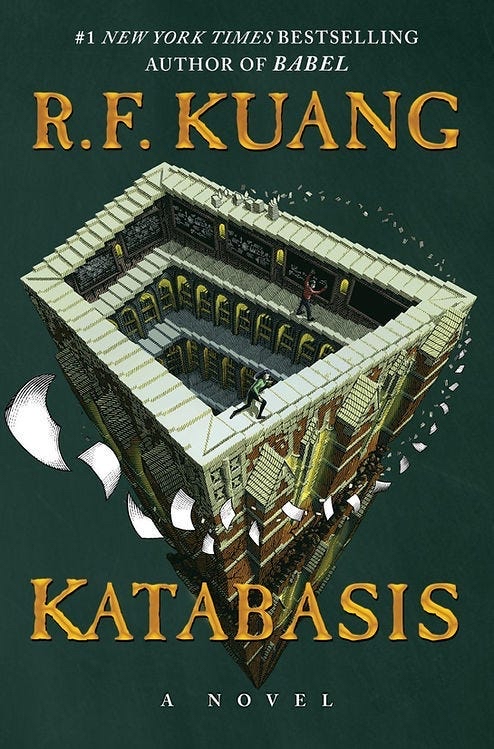
Katabasis follows Alice Law and Peter Murdoch, Cambridge PhD students in analytic magick. After a freak magick accident that kills their revered tenured professor, Alice and Peter traverse Hell to retrieve their professor’s soul in the hopes that his priceless recommendation letters will secure their futures in academia. For this journey, Alice and Peter must pack light, including necessities. Thankfully, they have enchanted water bottles (“Perpetual Flasks”) and protein-rich, high-calorie sticks (“Lembas Bread”) to keep them going, but the lack of enjoyable sustenance prompts flashbacks to their regular university life. These flashbacks include various depictions of Alice relishing in forgetting to eat and associating hunger with extreme focus and ambition. Embedded in this association is the suggestion that basic needs (i.e. eating) become secondary in the pursuit of academic success. This no-holds-barred prioritisation of academic success is corroborated by Alice’s willingness to risk at least half her lifespan, if not her whole life, for the chance at a recommendation letter. Is it through Alice’s obsessive and somewhat unreliable narration that self-starvation is romanticised and implicitly justified.
Well-Equipped for Hell: “Burdens of personhood”
When Alice is told about travelers in Hell who have sacrificed memories of their pasts in order to single-mindedly pursue a goal, she contradicts her peers’ discomfort and instead “didn’t find this so awful [. . .] if only she could unclutter her mind so that all that was left was the elements she wanted to keep: the burning core, the hunger for knowledge, the skills to gain it. You could achieve so much without the burdens of personhood. Who wouldn’t wash away the rest?” (145).
In hindsight, with all the future references to self-inflicted starvation to contextualise this statement, it becomes clear that Alice was largely referring to hunger as an unproductive “burden of personhood.” She is happy to pack light for her katabasis (meaning, “journey to the underworld”) because she is uninterested in sensory indulgences such as eating, and the chance to focus solely on an academic endeavour is ideal.
The fact that Alice is sympathising with seasoned Hell inhabitants more than her newly-arrived peers is telling. Is it a coincidence that Alice can survive the landscapes and navigate the traps of Hell so well, or is she suited to it? Is it a coincidence that several levels of Hell are inhabited largely by academics, and academia is Alice’s ideal profession? Considering Kuang’s status as both an Oxford and Cambridge alum, I am inclined to believe that academia’s association with Hell is a cautionary tale of university culture rather than a critique of intellectualism. Alice and Kuang have both encountered the worst of the worst on campus, and despite the justice seeing undeserving peers get what’s coming to them (i.e. eternal damnation), what is more unnerving to encounter in Hell than a familiar face? Having Alice surrounded by potential classmates and former students brings attention to her moral ambiguity and drives home Kuang’s point of “academia is Hell.”
Pride in the Face of Self-Inflicted Adversity: “She was above all a mind”
After considering how her obsessive academic focus led to the collapse of her last romantic relationship, Alice reminisces about how “She was very proud of the days that she forgot to eat. Not because she had any revulsion for food, but because it was some proof that she had transcended some basic cycle of need.
That she was not just an animal after all, held captive by her desires to eat and fuck and shit. That she was above all a mind” (237).
Preoccupied with pride, what Alice fails to learn is how denying basic needs is a privilege; those fearing their basic needs becoming inaccessible are not able to forget about them so easily. If inaccessibility to basic necessities leaves you unable to forget about those “burdens of personhood,” you are then unable to achieve the state of being “above all a mind,” busy as you are with acquiring necessities first.
Alice’s ability to forget her need to eat is impressive precisely because of her ample accessibility to basic necessities. Not only is Alice well-off enough to study abroad at a renowned university and pursue the notoriously unstable field of academia, but she has cheap nutritional alternatives (e.g. Lembas Bread) readily available. Her ability to forget about eating is a marker of her mind’s impressive capacity for focus and ability to combat indulgences to the point of total inconsideration.
Starvation, Separated by Status: “Orphans starving continents away”
While ruminating on the ethical difference between killing and letting die, Alice considers the possibility that “If letting die was so evil, were we responsible for not doing anything about world poverty? About orphans starving continents away?” (372).
Others experiencing starvation are considered to be suffering from it, a symptom of the world’s “evil” practice of letting die. Is Alice’s starvation different because the orphans continents away don’t choose to continue starving, while she does? Alice could have reminded herself to eat, but she’s proud to be hungry. Does autonomy change the ethics of starvation, or is starving always bad? Is starvation more or less evil based on the degree of choice involved? None of these questions matter much to Alice, who is only considering hypothetical starvation as a way to make tangible the difficult concept of letting die. But Alice’s phrasal variation when referring to other individuals’ starvation versus her own reveals how she views the role of choice in starvation. When it is the result of unfortunate circumstances, starvation is an evil; when elected by the rich, starvation is a privilege. Although Alice does not explicitly state that the “orphans starving continents away” do not choose starvation the way that she does, there is some grammatical allusion to it. This phrase’s immediate placement after mentions of poverty—a circumstance never deliberately chosen, outside of select religious practices—assumes a link between the orphans’ starvation and their lack of choice. Starvation’s mention in proximity to responsibility of evil (ie. whether letting die is so evil) frames this form of non-autonomous starvation as being undesirable and even evil, further implying a lack of choice.
What separates the orphans’ starvation from Alice’s is their lack of autonomy, their inability to escape their suffering, and the consequent tragedy of their circumstances. Alice’s autonomous role in her starvation effectively removes her from the standard image of “orphans starving continents away”, and the ambiguous ethics of recreating that experience. It’s not as if Alice is slumming starvation; it’s that she is so focused that she forgets.
Final Thoughts
Whether Alice’s fallibility is merely a well-written character flaw or a product of Kuang’s flawed thinking is up to readers’ discretion. However, given Kuang’s propensity to over-explain, the lack of explanation given to Alice’s obsessive eating habits feels comparatively lacking. We can’t blame Alice for maintaining her perspective when her katabasis corroborates it; she believes that sustenance is secondary to success, and she does succeed with very little sustenance. Maybe this explanatory inconsistency is because Kuang wants to focus more on academic material than the detriment of heavily studying it—but this, too, is a recurring theme that Kuang deeply explores. Having hunger provides no significant obstacle sets a dangerous, romanticised precedent of starving student success that Kuang could have offset with a comment from any of Alice’s peers, or even a particularly bad hunger pain.
In forgoing her basic needs, temptations, and the questionable ethics of slumming, Alice Law proudly represents herself as a self-inflicted starving student. And this is often unbearable to read. But, despite her faults, Katabasis did have me rooting for Alice. Invoking readers’ empathy alongside distaste is something Kuang accomplishes especially well, and makes the novel far more entertaining than frustrating.
Contributed by L.F. Shubert


Leave a Reply