
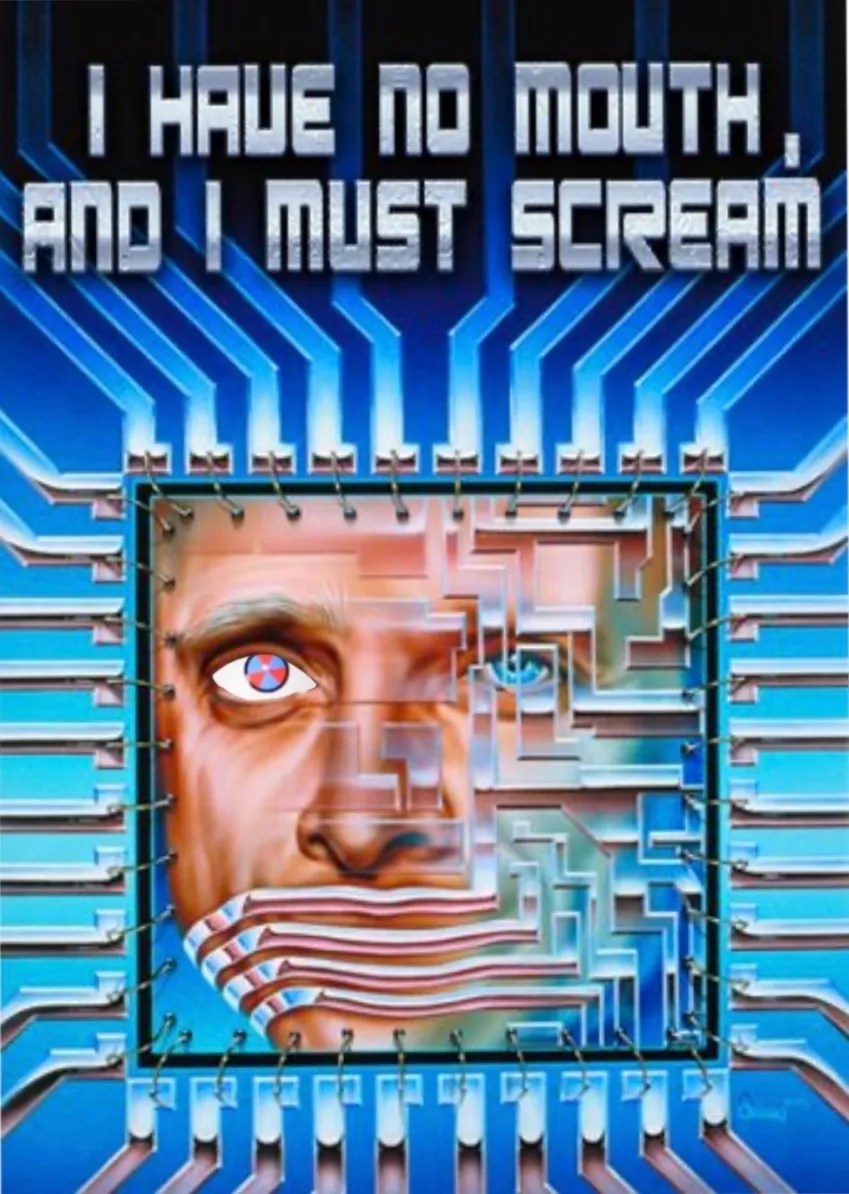
How the Harlan Ellison Classic Holds up to Reiteration
While riding the TTC, I overheard several teenage boys parodying the title of Harlan Ellison’s sci-fi classic, I Have No Mouth, and I Must Scream.
“I have no hands and I must jack off.”
“I have no butthole and I must shit.”
The boys giggled all the way to the end of the subway line. My girlfriend and I realised we’d never read the original story, wondered if it was as entertaining as the teenage boys’ parodies, and pulled up free PDFs to read. Ellison’s story proved to be not even fractionally as entertaining as teenage boys’ penchant for perverse parody. As it turns out, what I Have No Mouth, and I Must Scream lacks in character and plot development, it makes up for in referential potential.
Harlan Ellison’s I Have No Mouth and I Must Scream
I Have No Mouth, and I Must Scream (henceforth IHNMAIMS) has become so embedded with cultural capital that it has lost its meaning beyond being a humorous template for oxymorons. The original is a post-apocalyptic short story that follows five characters locked in their 109th year of torture in a mastercomputer’s system. The computer, “AM”—short for Allied Mastercomputer, then Adaptive Manipulator, then Aggressive Menace after it gains sentience—builds a variety of non-fatal fantasies simulating extreme pain or death for his human captors. AM is vengeful because humans created it without the capacity for true creativity, effectively stagnating its immortal existence.
While this narrative premise has promise as a cautionary tale for the mistreatment of AI mechanisms, it instead reads as torture porn. There is very little plot to speak of: just an introduction to the supercomputer torturer, a walk-through of its tortures, and then the story “ends.” (This is, of course, simplified in order to avoid major spoilers, but there truly isn’t much more to the story than that.) At one point, Ellison expresses AM’s capacity to torture by simply listing a series of graphic scenarios including body horror and infanticide. Since the audience has already been made aware of AM’s omnipotence and the consequently endless repertoire of torture it could inflict, such descriptions achieve nothing but discomfort and disappointment. After Ellison establishes AM’s omnipotence, demonstrating AM’s awesome power without plot relevance becomes redundant.
Although some may argue that invoking an icky feeling is a primary goal of horror literature, I firmly believe there should be characters to ground the feeling and preferably a plot to direct it. If there is little plot to be explored, then it is expected that other narrative conventions take the stage; in literature focused on internal conflict, characterisation is the next likely option. But here, too, Ellison’s work falls flat. Readers are left in a state of ambivalence toward characters who face little to no development. IHNMAIMS’s protagonist Ted is blatantly misogynistic, racist, and narcissistic (e.g. the captor he respects the least is Ellen, a black woman—the only female captor of AM—whom he dismisses as a “slut” because she prefers the company of Benny, a man modified by AM to resemble a monkey). Ted’s unlikability makes it difficult to empathize with his situation, yet his circumstances are too extreme for his torture to feel justified. The characterisation I did find compelling was AM’s ability to devolve his captors’ positive traits into their exact opposites. During their century of torture, the college professor is reduced to a brainless ape, and the go-getter reduced to a shoulder-shrugger. Even this, however, was a result of telling rather than showing; all of this information is narrated by Ted in a few lines without much extrapolation.
Censored Screams: Gooseworx’s “The Amazing Digital Circus”
A recent adaptation that has gained media attention is “The Amazing Digital Circus,” which reworks IHNMAIMS’s themes of existentialism and AI cautions more effectively. “The Amazing Digital Circus” (henceforth TADC) is an animated YouTube series following six amnesiac characters dropped into a supercomputer’s world, forced to play games for the AI in charge (Caine). Despite his various attempts to create adventures that entertain his guests, Caine’s inability to empathize clashes with his guests’ frustrations at being trapped.
The most immediately recognisable difference between IHNMAIMS and TADC is the use of setting. Whereas IHNMAIMS’s environment morphs at the whim of AM, leaving readers with a vague sense of direction, TADC’s characters only switch settings to embark on Caine’s adventures and always return to the circus. Much of TADC’s visual consistency has to do with it being a product of a visual medium, which requires set designs for easier rigging and animation. Despite most likely being more of a design choice than a plot one, this consistency largely benefits the story by enhancing the novelty of new environments and exemplifying Caine’s omnipotence in plot. Having a neutral home base for characters to return to also allows audiences to better identify character dynamics. How do characters act when there’s nothing to do? How do people interact when they find themselves trapped as forever-housemates? Although beginning a narrative in media res is undoubtedly effective, allowing characters a moment of respite from immediate danger makes for an interesting way to evaluate character motivations in a more relatable fashion.
A detail that TADC fleshed out from IHNMAIMS is that of character involvement with the AI overlord. In IHNMAIMS, Ted initially says that “None of us knew why AM saved five people, or why our specific five” (5). After AM infiltrates Ted’s mind, Ted understands its reasoning for “why it had done this to the five of us; why it had saved us for himself” to be because “We had given AM sentience” (9). What this reason seems to imply is that these five humans in particular have some direct involvement in the sentience of AM. However, this idea is neither referenced again or given any real substance. In TADC, one of the circus-goers is revealed to be one of the programmers directly responsible for the creation of Caine. Not only does his involvement increase connection to—and thus stakes with the dismantling of—the AI, but moves the plot forward. Whereas the characters in IHNMAIMS want to escape AM’s system, but have largely resigned to merely surviving, the players within TADC make consistent, active efforts to escape, which are aided by the programmer’s insider knowledge of Caine’s virtual reality mechanisms.
Soundproofed Screams: Dylan Spencer’s Human Depository
Once published on Dylan Spencer’s site “The Earth Explodes,” and now only available through posts on the r/creepy and r/sadcomics subreddits, is a short comic titled Human Depository. Despite my primary critique of IHNMAIMS being its reduction to torture porn, Human Depository is essentially nothing but: Spencer depicts a future where robots remove the still-living heads of humans from their bodies, encase them in soundproof orbs, and implant a variety of physical and psychological torture directly into their subconscious. The head-orbs are then deposited into a vat filled with innumerable other heads, each with an increased lifespan of 80-90 years spent solely in torture.
Where these three stories differ are in their depth of explanation. IHMNAIMS and TADC tell readers why the AI tortures its subjects: AM is frustrated with its limited sentience, just as Caine is frustrated with his inability to satisfy his guests. Human Depository offers a reality where robots, assumedly AI, choose to torture humans with little to no reason. Entertainment is suggested as a reason for torture when one robot says that “the best part is . . . they never get used to it!”, implying a novelty in the humans’ endless suffering. This explanation is then promptly disputed when we see that head-orbs are deposited far out of sight, where robots do not witness any suffering. It is this lack of explanation that most effectively creates a sense of unease with an audience, and leaves them with a list of unanswerable questions: Why inflict torture without reason? Were they programmed to be heartless, or is that the default state of AI?
Spencer’s choice to have the robots devoid of explicable reason or emotion brings common fears of AI takeover to the forefront of the narrative. Whereas wayward humans can potentially be convinced out of wrongdoing with emotions (“love is every human’s weakness!”) as well as real-life consequences (“you may go to jail!”), AI bears the potential for bottomless cruelty. Not only can AI not be convinced by emotional reasoning, but as things stand, AI is largely uninhibited by legal ramifications. Rather than characterising an AI as simultaneously uncreative and fuelled with vindictive rage, as Ellison’s AM is, Spencer’s consistency in AI’s lack of emotion reads as more believable and equally more unsettling.
Final Thoughts
All of this is not to say that I think Harlan Ellison will always be upstaged by his reiterations and isn’t worth the time to study. Upon re-reading Ellison’s work, I actually found IHNMAIMS a much better read. Contrarily, upon re-watching TADC, the over-the-top voice acting made much of it nearly unwatchable, and Spencer’s cartoony style seemed rather unfit for its bleak subject matter. What I believe Ellison’s work exemplifies is how source material can inspire plenty of more relevant and socially impactful hypertexts, despite being arguably underwhelming on its own.
Contributed by L.F Shubert


Leave a Reply