
In 2025, Warner Bros. Pictures released Weapons, the second horror film from director Zach Cregger following his successful hit Barbarian from three years prior. With great anticipation leading up to the film’s release, it’s safe to say it did not disappoint, garnering a score of 93% on Rotten Tomatoes and an Academy Award. While the majority of the film’s praise goes to Amy Madigan’s acting, I was more fascinated by the structure and writing of the film’s plot. More specifically, I was intrigued by Cregger’s use of “mystery box” storytelling, which he doesn’t just use to create suspense, but weaponizes to expose the failures of dysfunctional communities and their neglect of children.
To clarify, the mystery box was a term coined by filmmaker J.J. Abrams during a presentation he gave at the TED2007 conference to describe his approach to storytelling, as seen in his projects, most notably Lost. To summarize, Abrams explained that mystery box storytelling does not give answers immediately, but rather focuses on establishing questions to hook the audience. Rather than info-dumping viewers, a chain of curiosity is created, where even the answers which are given lead to more questions. By intentionally withholding information, more tension, intrigue and anticipation are created for the audience through a slow-burn reveal.
This concept, which Abrams noted had existed before his career, has garnered a mixed reception since he popularized it, with both positive and negative uses of the style. Fortunately, Weapons ended up on the better side for the majority of viewers. I found Cregger’s application of the method to be fascinatingly unique compared to other portrayals, but it wasn’t just a gimmick; it directly improved how the story explored its themes.
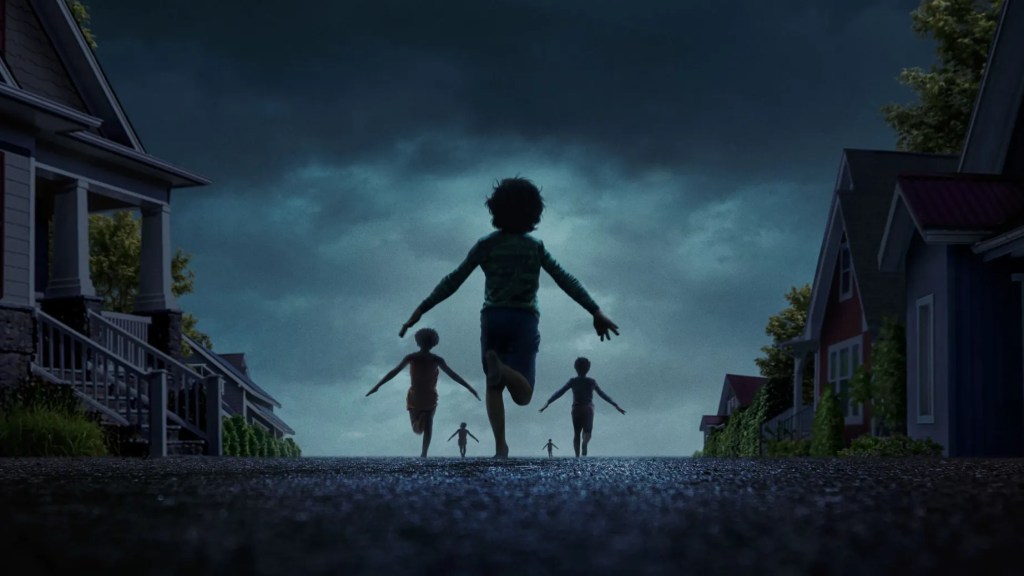
To set the stage, the mystery of Weapons centres on an unexplainable event: one night, in the town of Maybrook at exactly 2:17 AM, 17 out of 18 children in a third-grade class simultaneously wake up, run out of their homes with the same unnatural posture, and vanish mysteriously. What’s left is a community of confused investigators, grieving parents, a silent survivor, and a scapegoated teacher.
To keep in line with the mystery box, Cregger fragments his narrative, describing the story as “passing the baton between characters for 12-minute chunks, giving each a moment to be the star of the show.” By keeping each character’s story separate, he withholds answers to the mysteries, but this also has broader implications.
To start, this fragmentation links back to the theme of dysfunctional community as we see different layers of Maybrook’s society. Many of the film’s leads show a different side of this dysfunction. Justine Gandy, the teacher of the missing third-grade class, is caring but deeply reliant on alcohol, even having an affair due to it. Archer Graff, the father of one of the missing children, represents the town’s mob mentality and toxic scapegoating of Justine. Paul Morgan and Marcus Miller, a local police officer and the school principal, respectively, showcase how authority figures are more concerned with controlling situations than solving them. And finally, James, a local drug addict, only searches for the missing children for financial gain. Fragmenting the narrative allows for these various depictions of different levels of society to fail at their responsibilities, further solidifying the idea of a dysfunctional community.
Building on this, the previous perspectives create a second, more thematic mystery box that is resolved with the first one (being the missing children’s incident). The final perspective of the film follows Alex Lilly, the one child from Justine’s class who did not run away. In terms of functionality, Alex’s perspective serves to reveal the answers that the previous characters have been missing the entire time—in a supernatural twist, the children were possessed by a witch named Gladys, who isolated them and fed off of them to sustain her life.
However, thematically, it creates a broader message of how society fails children. Withholding Alex’s perspective to the end allows us to see the horror he faces only after witnessing the adults’ failures. Each of the adults’ perspectives only packs more and more into the final punch at the end, where we don’t just see a boy terrified by a supernatural threat, but the very true-to-life fear of being abandoned by a world meant to protect you, right when you need them most. This method creates the second mystery box. The previous perspectives weren’t just setting up clues to answer “What happened to the children?”, but they were also answering the mystery box surrounding “Why did we let this happen?”
It’s important to note that the mystery box itself becomes symbolic here. No one is able to solve the mystery because the community of Maybrook is so divided and dysfunctional. Instead of working together, they choose to take inappropriate measures, such as scapegoating Justine and vandalizing her property, or simply ignoring the situation altogether. The only two characters who are able to fully solve the film’s mystery are Justine and Archer, and this is only after the two reconcile their differences and admit their faults. In this way, the mystery box is not just a storytelling device, but a product of Maybrook’s fractured society, and it only “opens” when unity replaces disorder.
The impact of fractured societies on youth has always been such a fascinating theme to me, yet I never see it in narrative media enough. So, for Weapons to release and intelligently adapt the idea was immensely refreshing and exciting. Cregger elevated the mystery and horror miles beyond convention, using unanswered questions to mirror the negligent and fractured realities many children face today. The horror of the mystery’s resolution does not come from its supernatural nature, but rather from how preventable it could have been. With that, Weapons doesn’t just solve its own mystery box of supernatural horror, but that of our society’s own failures.
Contributed by Emon Hossain
WORKS CITED
Abrams, J.J. “The Mystery Box.” TED2007: Icons. Geniuses. Mavericks., 9 Mar. 2007, Monterey Conference Center, Monterey, CA. Conference Presentation.
Barbarian. Directed by Zach Cregger, 20th Century Studios, 2022.
Cregger, Zach. Weapons. Deadline Hollywood, 2026, https://www.documentcloud.org/ documents/26460895-weapons-read-the-screenplay.
Lang, Robert. “‘Weapons’: Read The Screenplay For Zach Cregger’s Horror Mystery That Turns A Community’s Grief Into A Nightmare.” Deadline Hollywood, 7 Jan. 2026, www. deadline.com/2026/01/weapons-script-zach-cregger-horror-movie-1236665720.
Lost. Created by Jeffrey Lieber et al., ABC Studios et al., 2004-2010.
Saldana, Zoe. “Presentation of Best Supporting Actress.” The 98th Academy Awards, 15 Mar. 2026, Dolby Theatre, Los Angeles, CA. Presenter Speech.
Weapons. Directed by Zach Cregger, Warner Bros. Pictures, 2025.
“Weapons.” Rotten Tomatoes, 17 Apr. 2025, www.rottentomatoes.com/m/weapons.


Leave a comment