[This post contains major spoilers for season five of Stranger Things, as well as mentions of death and suicide. Minor references may also spoil season eight of Game of Thrones and the film Doctor Strange in the Multiverse of Madness. Please proceed with caution!]
In 1999, future comic book writer Gail Simone coined the term “women in refrigerators.” As a fan of comics who also happened to be a woman, she couldn’t help noticing that the vast majority of female superheroes always seemed to end up killed, maimed, or depowered. Simone set out to create a list of all the instances of this phenomenon in order to better understand it. In doing so, she realized that, contrasting the noble deaths that male heroes receive, these female characters tend to be killed off as a plot device to further male characters’ development. The motivation is often shock value—but audiences are no longer surprised.
Simone’s “Women in Refrigerators” website shone a light on sexism in pop culture, especially in the comic book industry. As discussion grew in the 2000s, Simone’s phenomenon became known as a trope called “fridging.” Critics and consumers of media began to notice its presence not just in comics, but in film and TV franchises. The trope now typically refers to any female (or otherwise marginalized) character whose death serves to motivate a male protagonist.
However, at the same time as we enter an era of media in which the problematic aspects of “girl power” feminism are being recognized (see: Greta Gerwig’s Barbie), it seems Simone might need to make a new list. Even at the time she formulated her theory, Simone saw improvements in the representation of female characters and creators in the comic book industry. So, 25 years later, why are we once again seeing this many superpowered women killed off in media? Either there has been a gross misinterpretation of what post-girl power feminist representation means, or sci-fi and fantasy media haven’t actually progressed that much since the 1990s.
I hesitate to say that there has been no progress over the past three decades. Even in the traditionally male-dominated genres of sci-fi and fantasy, representations of female empowerment are much more common than they were in the late twentieth century: Rey in the Star Wars sequels, Captain Marvel entering the MCU, and Katniss Everdeen in The Hunger Games, to name a few. I do believe, though, that the road of progress has contained many twists and turns. Issues of feminist representation are complex, and not everyone agrees on what “good” feminist representation entails—hence the controversy surrounding even those characters I just listed. In the search for the right way to write women, sci-fi and fantasy media have taken numerous detours, including the “token woman” and the so-called “strong female character.” We have yet to reach the era of media in which representations of women are unproblematic. My hope lies in the post-girl power wave of feminism, in representations that allow female characters to be human rather than flawless paradigms of “strength.”
The recent shift to this kind of representation is what makes the concurrent regression to pre-girl power representational tropes so startling. In the world of sci-fi and fantasy, it is incredibly easy to name a plethora of male characters with immense amounts of power. Their female equivalents, by contrast, are few and far between. Narratives seem to have a difficult time containing superpowered women. They are much quicker to be labelled “overpowered,” and much quicker to be killed off out of convenience because the writers cannot come up with a more satisfying conclusion to their stories. No one knows what to do when women gain too much power, so naturally, they have to die.
In 2019, Game of Thrones killed off Daenerys Targaryen in order to motivate a male character (Jon Snow), just as the extent of her power began to pose a threat. Because, obviously, mystical abilities and great political power will cause a woman to go insane, and, obviously, the only solution is to butcher her character—both literally and figuratively.
In 2022, Marvel’s Doctor Strange in the Multiverse of Madness killed off Wanda Maximoff (the Scarlet Witch) after unlocking a new level of power abruptly transformed her into a crazed villain. Unsure what to do with one of their most complex and powerful characters, Marvel opted to turn a traumatized female superhero into a one-dimensional obstacle for the film’s male protagonist.
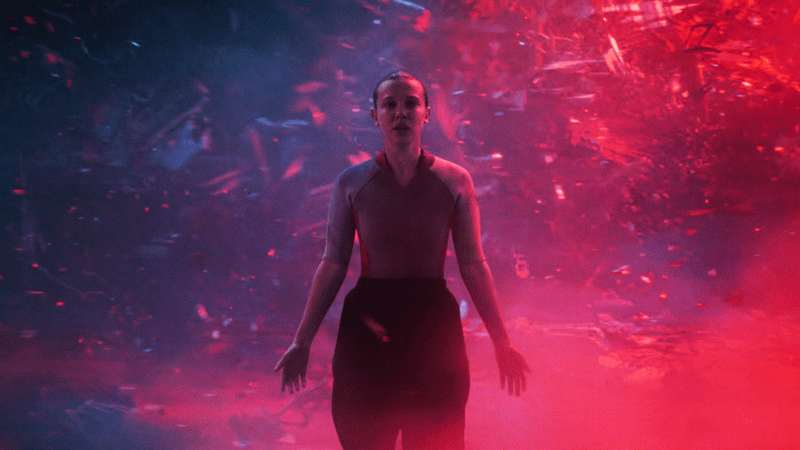
And in 2025, Stranger Things killed off Eleven.
Now, this wasn’t exactly a surprise. If you’d asked me in the summer of 2024, after months spent binging the first four seasons on repeat, who I predicted wasn’t going to make it through the finale of the hit series—El would’ve been at the top of that list. I envisioned an epic heroic sacrifice in a final mind battle, one that tied her fate to that of Vecna/Henry/001 and finally allowed her to gain power over one of her former abusers. I prepared myself to sob but ultimately walk away satisfied with the arc of a superpowered female character finding internal strength and learning to stand on her own. I was not prepared for her to be sidelined and martyred in the final season of her own show.
From the beginning of season 5, El’s arc was fairly surface-level compared to season 4’s deep exploration of her trauma. She was separate from her friends, devoting all her time to training for her inevitable reunion with 001, and dealing with an immense amount of pressure. El’s sense of personal responsibility for the Party’s safety and Vecna’s defeat seemed to set up an interesting storyline in which she would naturally be proved wrong and learn that it’s not all on her to be the hero. (It is, after all, a coming of age show inspired by ’80s films.) This wasn’t the case. Out of all the (many, many) characters in the final season, the supposed female protagonist’s inner turmoil was never a focus. Her storyline dealt instead with her adoptive father Hopper’s sudden relapse into suicidal ideation, and then the return of her sister Kali, whose motivations the show threw under suspicion.
When Kali started to convince El that she had to die, I actually started to believe that El would survive the final season. I mean, when has a screenwriter ever made the audience think a character was going to die just to actually kill that character? It wouldn’t be a very good plot twist, would it? “Okay,” I (and many others) thought, “maybe Kali is working with Henry to try and remake the world—it would make sense given her scorned and spiteful characterization, and it would fill in some plot holes about her escape from Hawkins Lab. Obviously, El isn’t going to listen to her. They’re not going to write a survivor of abuse who’s forced to kill herself to end the cycle. What kind of message would that send?”
Well, they sent it anyway.
Despite all their talk of the need to “land the plane” and write the perfect ending for their show, the Duffer Brothers went against every rule of screenwriting in order to execute one of the weakest plot twists in modern television, perpetuating an outdated and outright harmful trope in the process. After what was, frankly, an underwhelming final battle and an unsurprising final episode at large, El “chose” to stay inside the Upside Down as it was blown up. (Hint: Being forced by circumstance and influenced by another character is not the same as making a choice!) They could have had her live on and sent a message of hope to all those who related to her. They could have given her a noble sacrifice in the final battle, worthy of her heroic status. Instead, El’s death was framed as an act of suicide, and one that was necessary in order to clean up a supernatural mess she didn’t even make.
The worst part? It was one of the most blatant acts of fridging since Green Lantern’s dead girlfriend was literally stuffed into a refrigerator.
As if the epilogue didn’t make it obvious enough, the Duffer Brothers essentially admitted that El’s death was written purely to motivate the development of the other characters—namely Mike, the show’s male protagonist. In a post-season interview with Deadline, Matt Duffer said, “So the memories of Eleven are always going to be with Mike, and they don’t vanish, right? I mean, she’s going to be a part of Mike and her friends for the rest of time … Eleven and everything they went through shaped who they are today.” On its own, this could be taken as a sweet sentiment about grief. However, Ross Duffer’s statement in an interview with Tudum is condemning: “There was never a version of the story where Eleven was hanging out with the gang at the end. For us and our writers, we didn’t want to take her powers away. She represents magic in a lot of ways and the magic of childhood. For our characters to move on and for the story of Hawkins and the Upside Down to come to a close, Eleven had to go away.”
Apparently, the creators were only capable of imagining two possible endings for El: losing her powers, or death. Both forms of fridging, by the way. The story of a superpowered, traumatized, complex female character was ultimately nothing more than a plot device for the development of her male love interest and mostly male friends. Deja vu, anyone?
There is, of course, the argument that El’s ending was ambiguous. But even if she did survive, nothing changes. The narrative couldn’t contain her, so she had to “go away.” It’s fridging, plain and simple.
When will the superpowered woman get to make it to the end? When will her trauma be resolved in a meaningful way? When will her character be the focus of development? In other words, when will the story finally belong to the female hero?
Characters like Eleven, like Wanda, even like Daenerys—maybe the number one victim of an all-male writers’ room—carved a space for women and girls in the world of sci-fi and fantasy, a world in which our presence is constantly questioned and belittled. Recent depictions of female characters who hold the same amount of power as their male counterparts (or even more!) have had an immensely powerful effect on female fans of sci-fi and fantasy. Killing them off for shock value, for taking up too much space, or for standing in a male character’s way, only serves to reinforce the outdated narrative that women and girls don’t belong in that world. Unless we want to keep living in the past, there is no place for fridging in twenty-first century media.
If there’s one thing that can be said about the Stranger Things finale, it’s that the Duffer Brothers certainly took us back to the ’80s.
Contributed by Norah Ruch
Works Cited
Campione, Katie. “‘Stranger Things 5’: Duffer Brothers Unpack Emotional Series Finale From [SPOILER]’s Death To That 40-Minute Epilogue, Those Needle Drops & A Spinoff Hint.” Deadline, 1 January 2026, https://deadline.com/2026/01/stranger-things-5-finale-explained-creators-interview-1236659749/.
Dray, Kayleigh. “Game of Thrones season 8 has failed all of its female characters—especially Cersei Lannister.” Stylist, 14 May 2019, https://www.stylist.co.uk/long-reads/game-thrones-8-writers-anti-feminist-female-characters-backlash-daenerys-cersei/266884.
Duffer, Matt and Ross Duffer, creators. Stranger Things. 21 Laps Entertainment / Netflix, 2016-2026.
Hatchett, Keisha. “The Duffer Brothers Dive Deep Into the Emotional Stranger Things Series Finale.” Tudum, 2 January 2026, https://www.netflix.com/tudum/features/stranger-things-series-finale-duffer-brothers-interview.
Kataria, Uday. “The Infuriating Inconsistency of Wanda Maximoff.” Cosmic Circus, 6 May 2022, https://thecosmiccircus.com/the-infuriating-inconsistency-of-wanda-maximoff/#:~:text=Before%20she%20kills%20Reed%20Richards,flee%20from%20her%20in%20fear.
Simone, Gail. “Fan GAIL SIMONE responds.” Women in Refrigerators, https://lby3.com/wir/r-gsimone.html. Accessed 8 March 2026.


Leave a comment