
 Ghosts are real, that much I know.
Well, okay, I don’t know, but Edith Cushing (Mia Wasikowska) can certainly tell you a thing or two about ghosts.
Crimson Peak is Guillermo del Toro’s newest gothic romance film, and it possesses all of his trademark film-making techniques but with a distinctive late-1800s twist. The plot seems like something out of a gothic novel, with the basic premise being reminiscent of Edgar Allen Poe’s short story “The Fall of the House of Usher”.
Edith Cushing, an aspiring American author and the daughter of a successful businessman, falls in love with the mysterious Sir Thomas Sharpe (Tom Hiddleston), an English baronet. Their romance is complicated by the pointed glares Thomas’ older sister, Lucille Sharpe (Jessica Chastain), keeps sending their way. Throughout the Sharpe’s estate, which seems almost alive, there is a permeating feeling of wrongness, which the audience feels as well, given how fast Thomas is taken with Edith.
And therein lies the main weakness of the film.
Perhaps the plot is too Romantic. Thomas Sharpe plays the stereotypical role of the dashing male hero who woos the female protagonist, despite her somewhat humble origins. From the moment the two meet, the speed at which Thomas reads and takes an interest in Edith’s manuscript is astounding. Perhaps Thomas can teach me his ways to aid me in my readings for class?
He then proceeds to stare soulfully into her eyes, notice her presence in every frame, and even stand outside of her house, in the rain, waiting for her father to leave in order to catch her alone.
All that within just hours of meeting her.
Although this does successfully give the audience a sense of foreboding and even foreshadows the tragic nature of their relationship, the love story between the two seems to exist only to drive the plot forward.
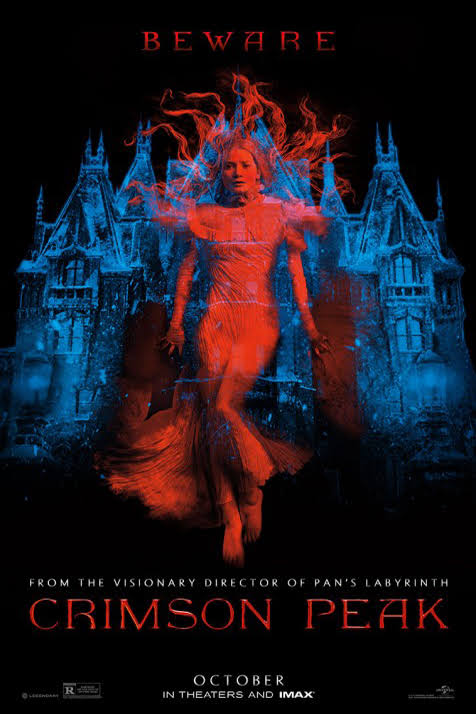
However, del Toro must be commended for his brilliant use of coloured lighting to build upon the tension and suspense of the plot. The constant interplay between amber and cool turquoise lighting reflects the conflict between Edith and Lucille, and by extension the conflict between the mortal and supernatural.
Edith and her American home are painted in warm orange tones that liven up the atmosphere, whereas Lucille and the Sharpe mansion are both drowned in a cool dark turquoise that infringes upon yet emphasizes Edith’s glow. The bloody red colouring of the ghosts is a nice horrific touch. But more, the colour adds significance to the purpose of the ghosts as figures caught between the light and the dark. Red is a warm colour, but its connotations are gory and chilling, like the turquoise, and the very opposite of the benign cast of orange. The ghosts are frightening in form, too, but once you reflect on their function and true purpose, are they really the antagonists here?
Crimson Peak’s cinematography also stands out in its combined use of sound and timing to create anticipation. The visual and auditory cues are predictable at times, but they call back to the style of old horror flicks. The close-ups on characters, the slow crescendo, the introduction of a horror element, the breathless pause, the abrupt zoom straight into the maws of a ghost—are all inexhaustibly thrilling in the way roller-coasters are. The fun isn’t lost despite the routine.
Overall this film was a worthwhile watch, even for someone who is deathly afraid of anything horror-related (i.e., me). Before entering the cinema, my biggest concern was that the film would be a simple translation of “The Fall of the House of Usher”, but instead it brought its own cinematic magic to the table. Watch, if not for del Toro’s imagery-laden visuals, then definitely for a few glorious moments of a view of Hiddleston’s bum.
-Contributed by Stephanie Gao


Leave a Reply