
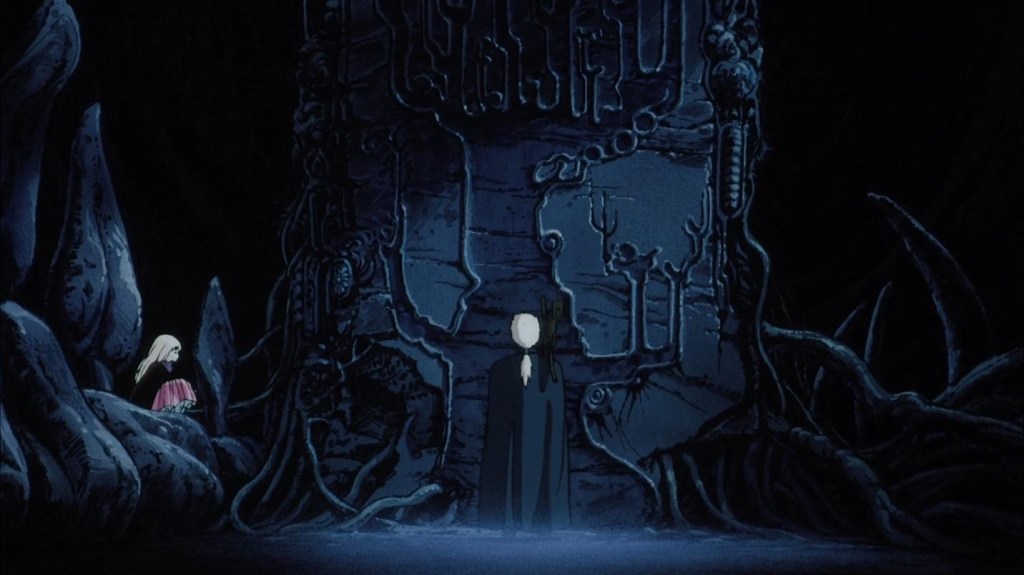
(Ahoy there! The following review contains spoilers for Angel’s Egg. It also features various descriptions and images of the atomic bombing of Hiroshima. In addition, there are slight spoilers with regard to the plot of Robert Eggers’ Nosferatu toward the end of this piece. Please proceed with caution.)
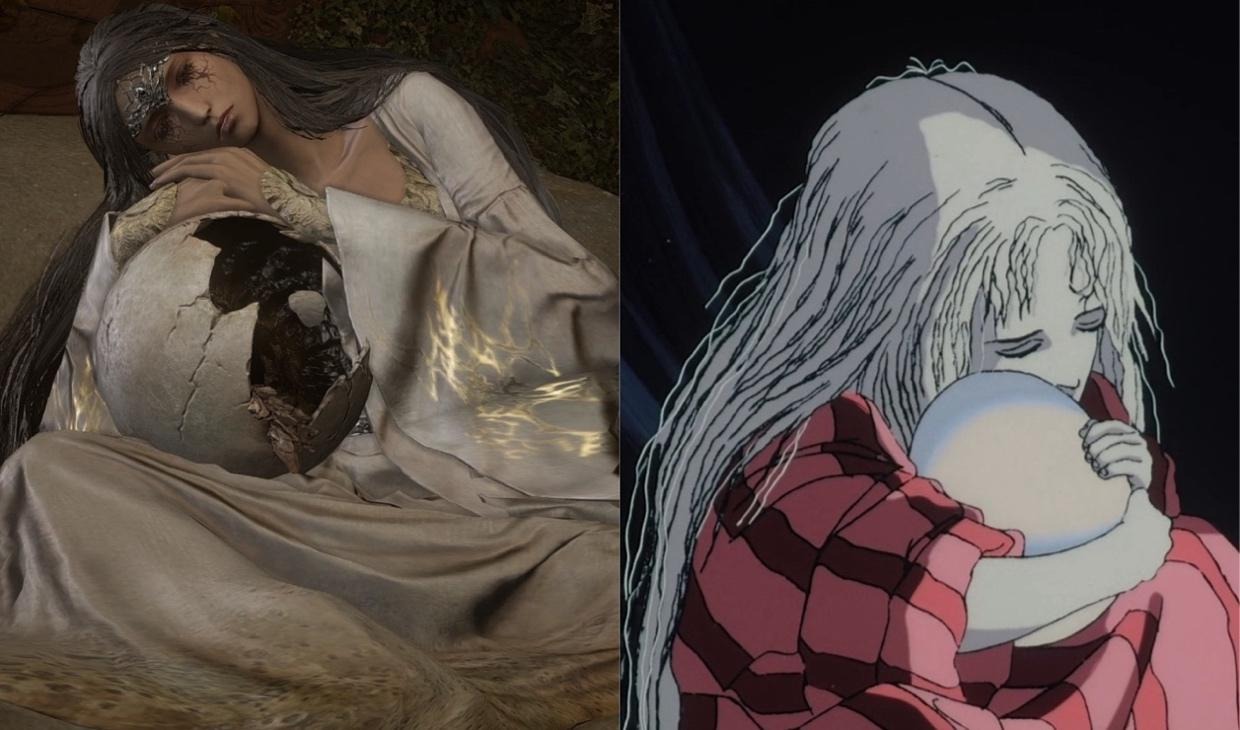
On November 19, 2025, I went to see the 4K restoration of Angel’s Egg, “under the supervision of director Mamoru Oshii himself,” in theatres. The film was first released directly to home video in 1985, but I was mainly aware of its legacy rather than the manner of its production: in today’s cultural climate, the image of the Girl holding an egg is most prominent in the widely adored or abhorred—depending on your personal standard for masochism—Dark Souls video game series (see fig. 1).
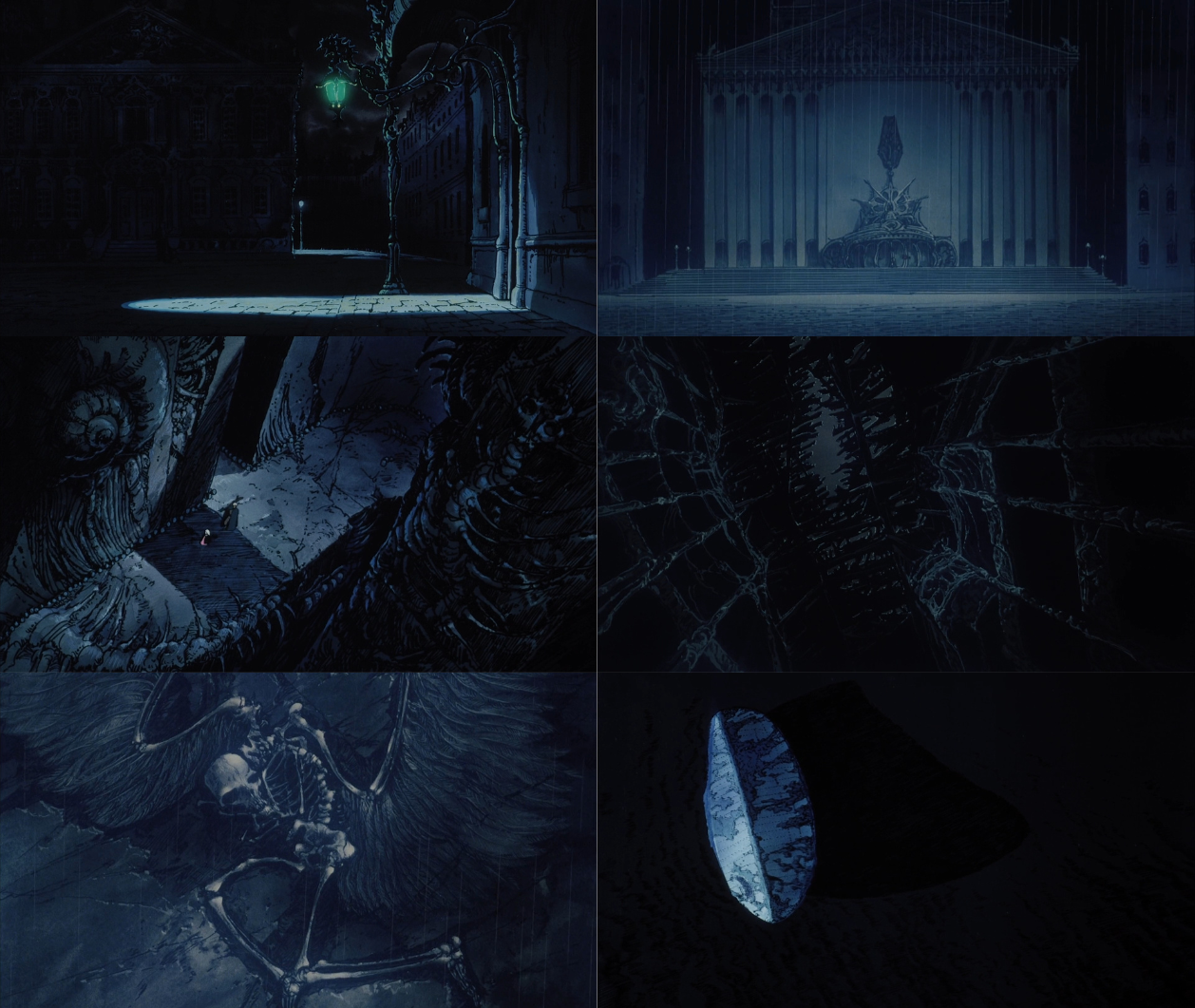
Angel’s Egg follows a nameless girl in charge of a mysterious egg. She shortly encounters and then travels with a boy soldier (also nameless) through a wild, abandoned landscape. The film’s beauty is not limited to Yoshitaka Amano’s ethereal, waxen character designs, or to its intricate city ruins that have likely played a hand in Bloodborne’s iconic Gothic Victorian setting—the themes are like dreams themselves, having eluded a definitive interpretation by critics or general viewers in the forty years since its premiere. When my audience realized that the film had come to an end, half of them were pleased; the other half were bewildered. As for myself, I had known what I would be going into. I had guessed that I would barely grasp what lay beneath the surface of the narrative, especially on my first viewing, and I turned out to be right. I came for the spectacular visuals, which far from disappointed me. I was therefore satisfied—I did not need a complete explanation of the story I had just witnessed.
Some reviews, however, are more determined to interpret the film. Jake Cole, writer of the most liked review on the Letterboxd page for Angel’s Egg, begins with an allusion to Theodor Adorno’s quote about the nature of making art following World War II:
If there can be no poetry after Auschwitz, there can be no faith after Hiroshima, in which mankind definitively proved its ability to create Revelation without the help of God. Oshii presents a world bleached by atomic fire, overcast in permanent nuclear winter and populated by leviathan skeletons forming building frames, diseased and aimless biomech weapons still marching in a war between long-dead sides, and shadows hunted by ghosts. Through it all are two humans, a girl who . . . fiercely guards an unhatched egg, and a cross-wielding boy who sees this possibility of new life amid all the death and can only think to destroy it.
About halfway through, the boy retells the story of Noah’s Ark but tweaks its resolution so that the doves sent to find dry land when the rains cease never return, and the boat just keeps roaming the endless seas. It’s one of the most intensely troubling monologues I can ever recall in a movie, a calm vision of existential absolute zero. . . . [It suggests] that rebirth can only happen at the point of final extinction.
The comparison is at once poignant as it is relevant: where Adorno was reacting to the devastating crimes against humanity that had been committed during the Holocaust, Cole highlights the catastrophic consequences of the atomic bomb in Hiroshima—a disaster that the West had celebrated for putting an end to the Second World War. In Cole’s view, the world of Angel’s Egg is identifiable as that of a nuclear holocaust. The perpetual darkness of the skies is attributed to nuclear winter; the cavernous, sparse, and dilapidated ruins mirror the bones of Hiroshima and Nagasaki; the “shadows hunted by ghosts” are reminiscent of the flash burn effect (see fig. 2).
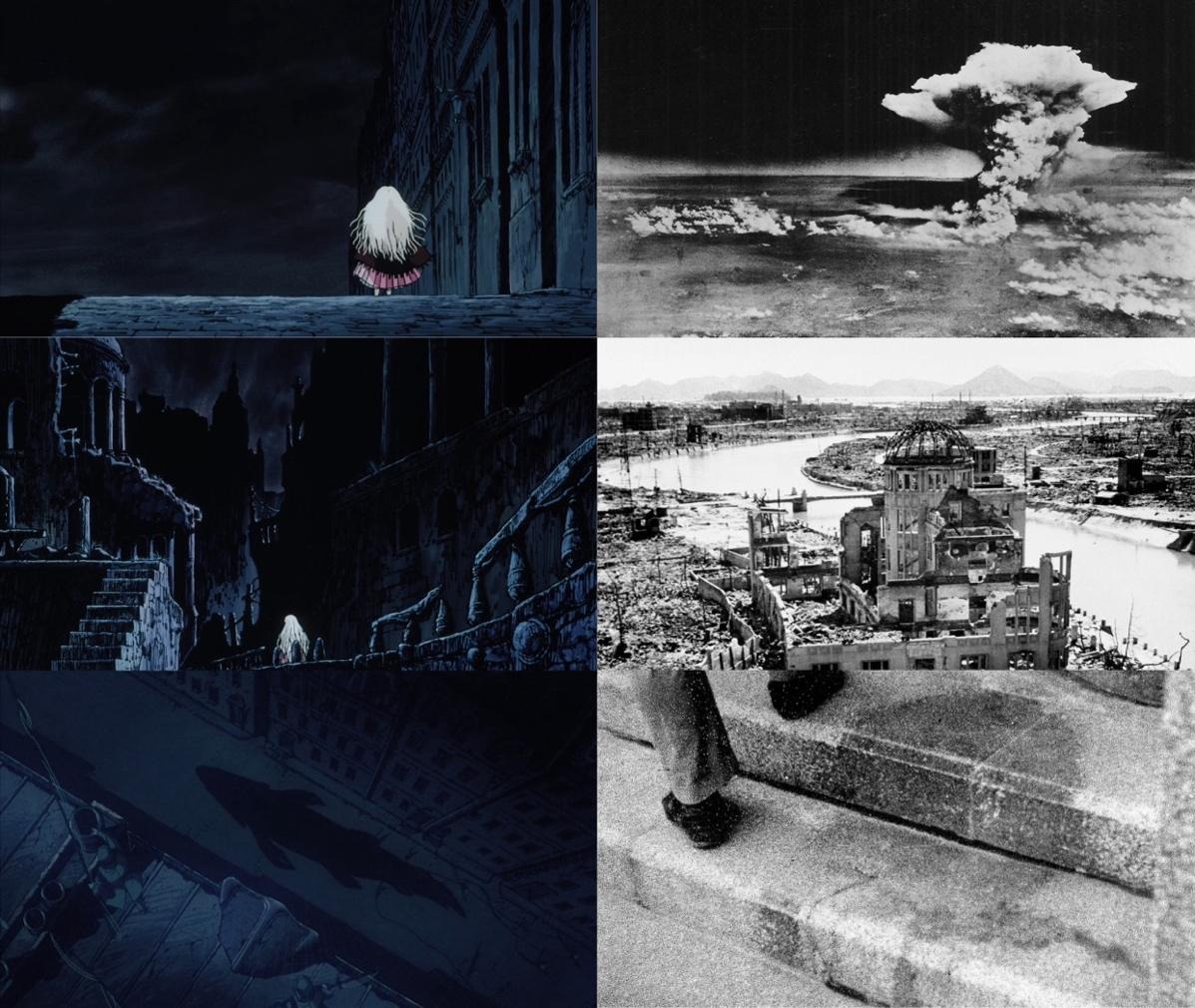
Cole claims that the film is primarily set in a post-apocalyptic future, where the Boy Soldier’s retelling of Noah’s Ark provides an ideological frame by which we can understand the nature of this world. The nuclear holocaust is the natural vehicle, the primary backdrop of Angel’s Egg, whereas the Biblical story of the Flood serves as the metaphorical tenor of its dystopian condition. As the Boy philosophizes, “Maybe no one really exists and it is only raining outside” (Oshii 00:44:11). His speculation alludes to the sheer barrenness of their surroundings: as far as both he and the Girl know, there is no sentient survivor beside them. Nature has overtaken what remains of civilization.
However, it’s difficult to ascertain whether this reading accounts for every aspect—much less scene—of the film. Cole’s observations of its visual allusions to Hiroshima’s nuclear disaster are certainly not unfounded. The Boy’s description of the tree mural that the Girl leads him to is especially damning (see fig. 3). At the same time, can there be a post-apocalyptic explanation behind the glowing lamps dotting silent streets and squares? The non-Abrahamic temple that invokes a mix of Classical and eldritch elements? The gigantic, fossilized exoskeletons that lie preserved in various structures and loom over the characters throughout their travels? What about the splintered, wooden ceiling resembling what could have been the deck of a great arc? The ossified, deformed bird—or, judging from its skull, human—skeleton? And finally, what can we make of the last, most shocking, zoom-out shot of the film: that the characters have been living upon a pale, oblong object in the middle of darkness (see fig. 4)?
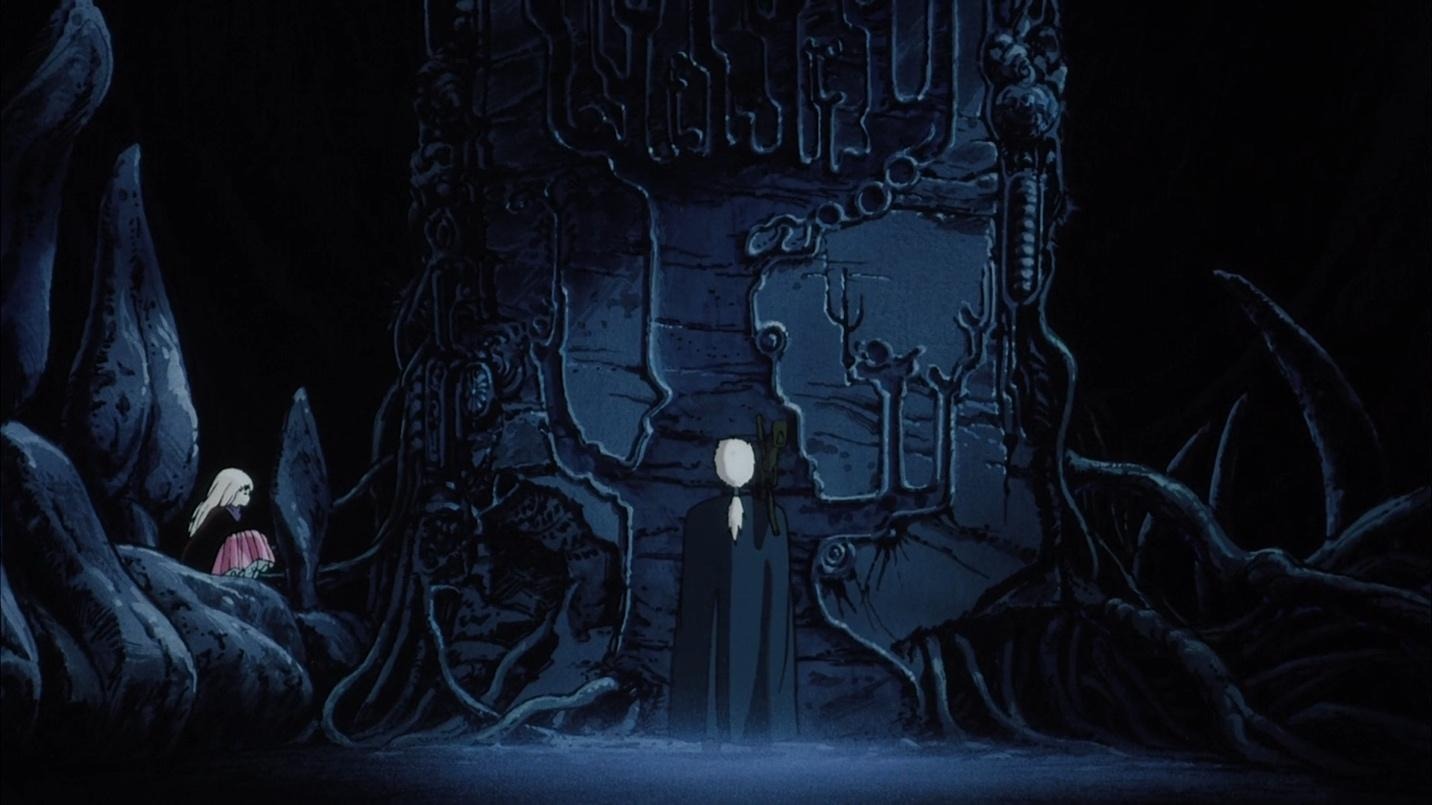
Perhaps the Boy’s story of the stranded Ark, forever doomed to drift about the roiling seas, is truer than we would think in this world. Since humanity has not, and will likely never, settle on land to recuperate from the Flood, all faith has been lost. Depictions of divinity are confused at best and distorted at worst; all remnants of animality are either petrified, prenatal, or perished; ichthyic creatures, whose natures alone are suited to living at sea, appear intermittently as ghostly fragments. Nothing is tangible nor harvestable, except for the presence of water. The camera slows down to stop and draws attention to the water fountain (00:18:54), the downpour of rain (00:28:40), and the countless jars of water that the Girl has painstakingly placed around a room with another monstrous skeleton (00:40:44). And yet, Oshii perverts what should be signs of life and fertility by presenting them with dread and stagnation. For instance, there is no one left to ensure the purity of the fountain’s water supply, or how long it will last. The Girl is seen scavenging for the perfectly sized jar to store water in (00:18:02), but how many more jars will she find before there are no more? What then? She has hopes that the egg she carries will someday hatch (00:46:13-00:46:23), and that the bird within will lead humanity toward the sanctuary they have been searching for, restoring order. But does the film confirm that there is a life present inside the egg?
Decades after the initial release of Angel’s Egg, Mamoru Oshii sheds more light, albeit non-explicitly, on its significance and legacy in a 2025 interview with Eli Friedberg. When Friedberg asks, “Many in the West view Angel’s Egg as a film about Judeo-Christian faith and its loss, . . . Do you believe transcendence or utopia are possible in the world we live in, and would you desire them if they were?”
Oshii replies, “I don’t deny the existence of religious emotion, passion, or faith. . . . though I don’t endorse any particular religion. I’m not an atheist, nor do I deny the existence of beings beyond humanity—but I believe that religion and faith are two entirely different things” (my emphasis). Let us return to Cole’s review, which concludes that the film is chiefly concerned with existentialism as tied to extinction. In combining his interpretive angle with Oshii’s statements, perhaps viewers could arrive at an in-depth understanding of the film, an exegesis that would suitably encompass the major themes and motifs of the object of its study. Perhaps it would be even clearer than my own review—I certainly admit that, after all these months, I still don’t understand Angel’s Egg any more than I did before entering the theatre.
Rather, I hope to use this post to showcase the wonderful art and ambiguity that are inherent in the piece of media it discusses. Instead of hoping to solve the mysteries behind the fantastical or allegorical concepts of the world, the real-life or philosophical sources of inspiration that Oshii draws on, or whatever contrasting forces that the Girl and Boy Soldier represent, why not accept that all of these possibilities hold true? To borrow from Princess Weekes’ delightfully insightful essay on Robert Eggers’ Nosferatu (2024), “There’s been a ton of . . . simplistic back-and-forth [discourse]” (24:53-24:56) regarding the nature of the relationship between its female protagonist Ellen and the antagonist Count Orlok. Either Ellen is an innocent, hapless victim at the hands of Orlok, or Orlok himself represents her suppressed sexual desires, which would render their encounters as expressions of catharsis. But Princess Weekes insists—and so do I—that arguing for one analysis over the other as a film’s ultimate meaning will shallow its narrative depth. True complexity lies in multivalence. Suffice it to say, it isn’t impossible to recognize multiple meanings and interpretations as viable in their own right. Perhaps we need to engage with and embrace ambiguity to even begin to grasp a work like Angel’s Egg.
For now, I leave you with the Boy’s retelling of the Flood from the Book of Genesis, complete with his speculations at the end. Perhaps you will find more answers in it than I ever will:
“‘I will blot out man whom I have created from the face of the ground. Man and beast and creeping things…and birds of the air, for I am sorry that I have made them. I will send rain upon the earth forty days and forty nights. And every living thing that I have made, I will blot out from the face of the ground. And after seven days, the waters of the flood came upon the earth. On that day all the fountains of the great deep burst forth. And the windows of the heavens were opened. And rain fell upon the earth forty days and forty nights. The ark floated on the face of the waters. And all flesh died that moved upon the earth. Birds, cattle, beasts… All swarming creatures that swam upon the earth, and every man. Only Noah was left…and those that were with him in the ark. Then, he sent forth a dove from him…to see if the waters had subsided from the face of the ground. Then, he waited another seven days, and sent forth the dove. And she did not return to him anymore.’ Where did the bird land? Or maybe it weakened and was swallowed by the waters. No one could know. So, the people waited for her return…and waited and grew tired of waiting. They forgot they had released the bird. Even forgot there was a bird and a world sunken under water. They forgot where they had come from…how long they had been there and where they were going…so long ago that the animals have turned to stone. It was so long ago, I can’t even remember where or when I saw the bird. Perhaps it was a dream. Maybe you and I and the fish…exist only in the memory of a person who is gone. Maybe no one really exists and it is only raining outside. Maybe the bird never existed at all” (Oshii 00:41:40-00:44:19).
Contributed by Crescentia Kim
Works Cited
Angel’s Egg. Directed by Mamoru Oshii, Studio Deen, 1985.
“Angel’s Egg 4K | Worldwide release in 2025.” Angel’s Egg Anime, https://angelsegg-anime.com/en/. Accessed 18 Dec 2025.
“ANGEL’S EGG 4K Restoration | Official Trailer – In Theatres November 19.” YouTube, uploaded by GKIDS Films, 14 Aug 2025, https://www.youtube.com/watch?v=4X9LM3aTiyY.
Cole, Jake. Review of Angel’s Egg, directed by Mamoru Oshii. Letterboxd, 14 May 2018, https://letterboxd.com/jakepcole/film/angels-egg/.
Dark Souls III. Directed by Hidetaka Miyazaki, FromSoftware / Bandai Namco Entertainment, 2016.
Friedberg, Eli. “Mamoru Oshii on Why Angel’s Egg Could Never Be Made Today.” https://thefilmstage.com/mamoru-oshii-on-why-angels-egg-could-never-be-made-today/.
Matsuhige, Yoshito. Human shadow on stone by atomic bombing on Hiroshima – Sumitomo Bank, Hiroshima bank – around December 1946. 1946. Wikimedia Commons, https://commons.wikimedia.org/wiki/File:Human_shadow_on_stone_by_atomic_bombing_on_Hiroshima_-_Sumitomo_Bank,_Hiroshima_branch_-_around_December_1946.png.
“Nosferatu & The Gothic Appetite.” YouTube, uploaded by Princess Weekes, 28 Jan 2025, https://www.youtube.com/watch?v=hAmSspxYfaE.
United Nations. Photo # UN7757913. 1945. https://media.un.org/photo/en/photo-essays/moment-world-changed-forever.
United States Army. Firestorm cloud over Hiroshima. 1945. New York Time, https://www.nytimes.com/2016/05/24/science/hiroshima-atomic-bomb-mushroom-cloud.html.
 The Spectatorial

Leave a comment