
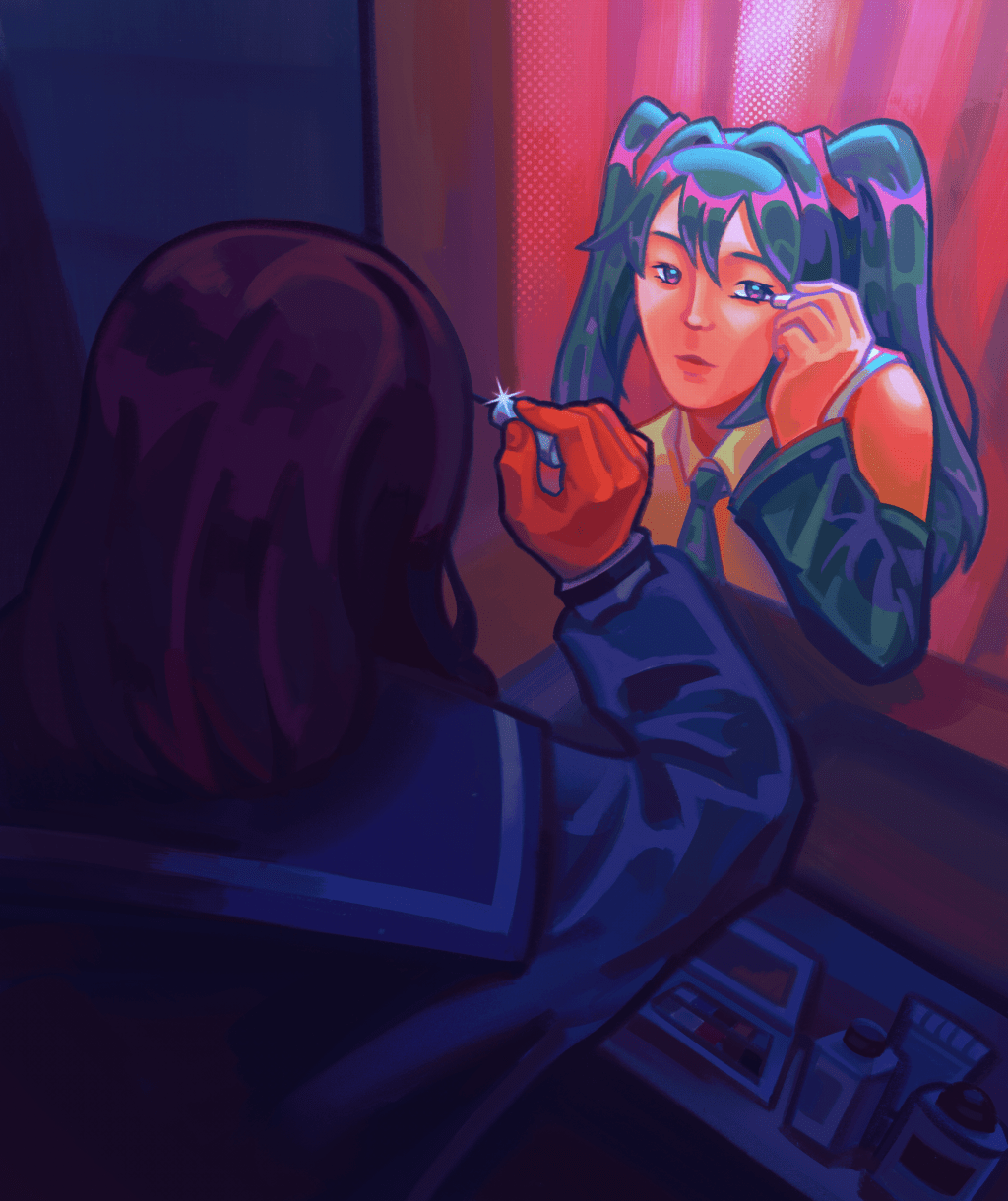
Originally designed as a humble mascot for a Crypton Future Media voicebank used by digital musicians, Hatsune Miku has become one of the most recognisable pop-culture icons of our generation. People have married her. People have used her to advertise pizza and haircare brands. She, more than any other VOCALOID character, has moved beyond mascot status and has entered the cultural zeitgeist as a symbol, a waifu, and an internet macro-celebrity. She sells out concerts where thousands of her adoring fans cheer her on, lightsticks in hand, as if a real person is actually singing on that stage instead of an .MP4 on an LED screen. She performed at Coachella!
For all intents and purposes, we all decided to collectively suspend our disbeliefs and treat Hatsune Miku as real.
But she’s not real, is she? Hatsune Miku is a product sold by Crypton Future Media, whose “voice” comes from snippets of Japanese voice actress Saki Fujita’s recorded phonemes. The people responsible for Hatsune Miku’s most successful songs are called producers, merely manipulating her voice to fit whatever song they want her to sing. Hatsune Miku has no original characterisation, no emotions, no voice of her own.
So what is Hatsune Miku? Is she a symbol? Is she the number one princess in the world? Is she a voiceless prisoner held captive to our musical whims? Is she a robot, or is she a girl? In this article, I present various VOCALOID producers’ songs grappling with Hatsune Miku’s un/reality, which range from scathingly cynical to gut-wrenchingly heartfelt.
I first began thinking about this topic when longtime VOCALOID producer PinocchioP’s “Anonymous M” came out in 2023. The song is presented as an interview between a human being and “Anonymous M,” a “music software pretending to be human.” Hatsune Miku critiques her own image as a tool for beginners trying their hand at music production, only to be discarded when they have outgrown her.
Rhetorically asking the audience “what image would you put on [her] lifeless body” amidst a backdrop of rubble, PinocchioP depicts Hatsune Miku not only as having a corporeal “human” form, but one that can be defiled by her producers. The implications for exploitation raised by PinocchioP are numerous: if Hatsune Miku has no agency over her own voice, then are we not committing an act of violence against her when we force her to sing? If Hatsune Miku has no agency over her own body, then…
(Although I do not legitimately think people who make suggestive imagery with Hatsune Miku are spiritually violate her, given recent controversies surrounding artificial intelligence and virtually exploiting female bodies—and the fact that PinocchioP’s most recent album is called META—I think these parallels are worth drawing, if only to critique our perceptions of women’s likenesses. If we only treat Hatsune Miku as a fictional character when we sexualise her, what does that say about the gender-based violence we cause to real-world women over the Internet?)
While sung by UTAU Kasane Teto, FLAVOR FOLEY’s “Spoken For” also depicts VOCALOID and other virtual singers as exploited idols, who can only sing the lyrics made by others; Jamie Paige’s Teto laments that she could be a canvas or a doll, before admitting that she does not view herself as “even something real at all.” If PinocchioP’s Hatsune Miku has no mouth and must scream, Paige’s Teto takes on a more subdued tone, seemingly having resigned herself to making music until she dies. Honestly, as someone who’s about to enter the 9-to-5 rat race… real as Hell.
Other VOCALOID producers turn to the more… romantic route when offering commentary on Hatsune Miku’s robotic nature. In Anamanaguchi’s “Miku”, Hatsune Miku playfully alludes to her it through sexually-coded language, inviting the audience to “play [her], break [her] … you can do anything you want [to her]” with a tongue-and-cheek tone. Given “Anonymous M”’s commentary on exploitation, however, I tend to interpret Anamanaguchi’s Miku’s desire for her fans to play with her as a bit sinister. This could not be more different from “Digital Girl” by KIRA, where Hatsune Miku begs the listener to not “uninstall her love” after threatening to break out of the screen and enter the real world. “How do you think I feel? None of this is real!” she protests, once again alluding to her role as a mere voicebox for the producer’s lyrics.
Finally, there are the sincere, #hopecore songs about VOCALOID’s role as glorified singing robots. Porter Robinson is no stranger to writing science fiction-inspired, electronic tearjerkers, and “Humansongs,” released alongside his custom VOCALOID Po-uta, is no exception. The song tells a story of Po-uta, a robot who outlived his creator, holding onto humanity’s music and “singing for [them] until [he] can’t talk.” “I’ve been teaching myself to cry / so that you know how much you’re loved,” he admits. Toraburota-P’s “Kokoro” uses a similar analogy of a lonely robot—the VOCALOID Kagamine Rin—wandering for centuries after its creator passed, pleading to the gods to grant her a heart with which she can finally understand her creator’s feelings. After receiving the heart, she says “these words of truth” as a love letter to the VOCALOID community:
Thank you…
For bringing me into this world
Thank you…
For the days spent together
Thank you…
For all you’ve given me
Thank you…
Forever I’ll sing
To me, Hatsune Miku is only as meaningful as the producers behind her music, the global communities that have come together from her image, and the phenomenon she represents. I would be remiss not to highlight YouTuber suzie’s cover of “Kokoro,” where she “tunes” Hatsune Miku (or adjusts the clipped phonemes from her voicebank to achieve a certain tone, timbre, and pitch) to sound like various influential VOCALOID producers’ versions of Hatsune Miku, including some producers that have previously been mentioned in this article! If imitation is the most sincere form of flattery, then suzie’s efforts to capture the exact nuances of every VOCALOID producer can only be seen as an act of sheer love. A fan even commented:
“I’m a native Japanese that’s been following Vocaloid from 2007. I got so emotional about how the undergrad niche community in Nico Nico, gradually turned into a massive international community that connects millions of people world wide.”
As for me, I don’t care that she only exists as a mascot for a music software designed for people who can’t hire singers. I don’t care that she’s not real. She’s real in my heart, and she becomes real through the people who love her around the world. Hatsune Miku becomes real through our sheer belief, with a passion that makes this little atheist understand why people believe in gods.
Hatsune Miku might not be human, but Hatsune Miku is humanity.
Contributed by Chris Wang
 The Spectatorial
Leave a comment