
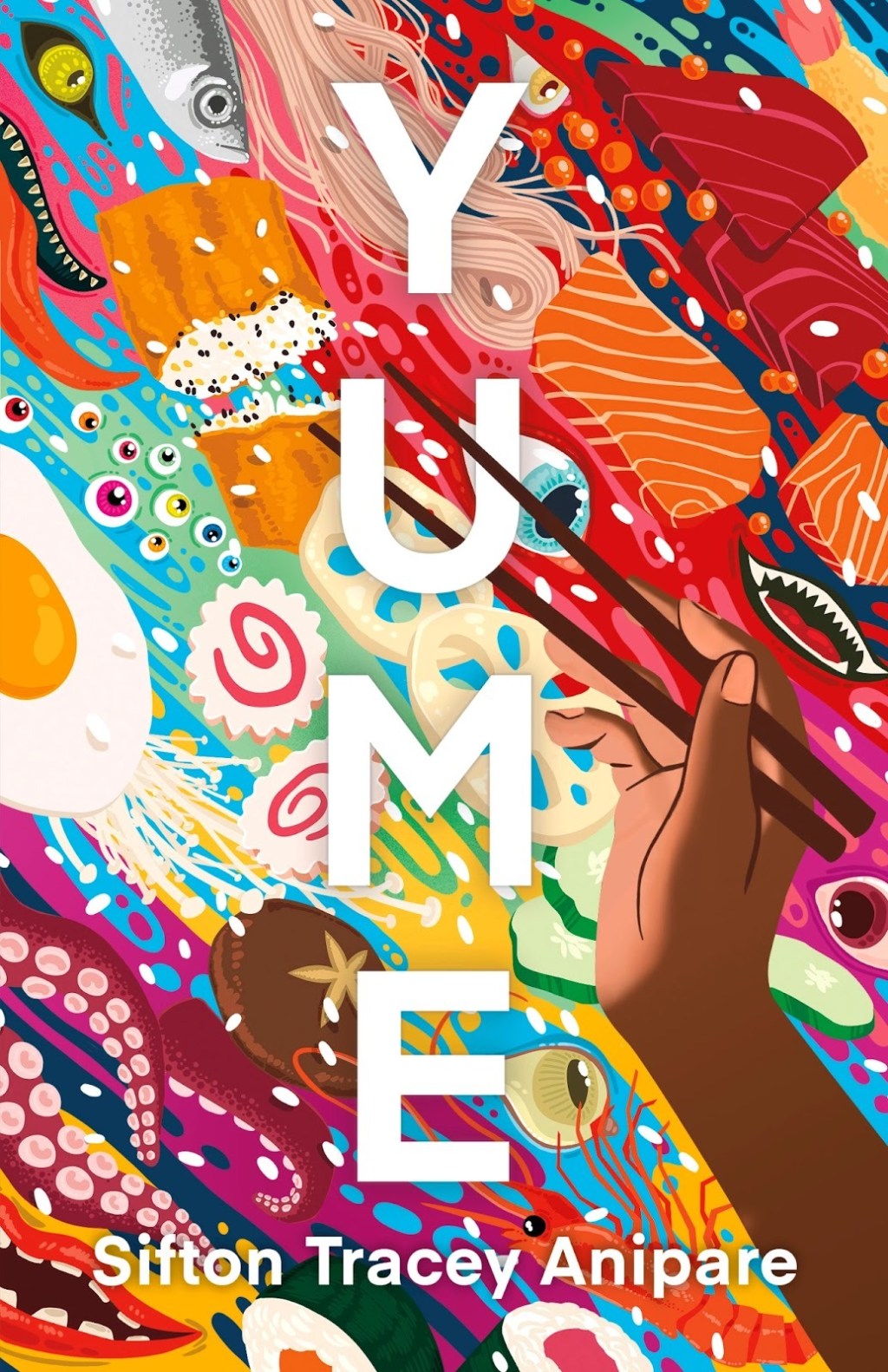
For the first time, I decided to go against Goodreads reviews and trust my gut. Lo and behold, it was wrong. Considering my own tendency to rate highly—and noting the abundance of five-star reviews on the site—I tend to be wary of any book with a three-star rating. Every book still gets a chance! . . . But a mediocre rating may serve as a bit of a warning. This time, I decided to discard any skepticism about Yume and bring it to the cash register regardless. The cover was pretty, nice to hold, and I’d recently gotten a bookmark to match its aesthetic; this seemed reason enough for a purchase to me. Plus, the synopsis was promising: a young language teacher’s slice-of-life blending into her increasing involvement with Japanese yokai? Sign me up!
Although on the slow side, the setup of the narrative made for decent light reading. Sifton Tracey Anipare’s characters had distinct and memorable personalities that suited both readers’ interests and the plot. It is a shame that characters were not able to develop as they might have with a more complex narrative, although the last third of the novel does offer some fantasy adventure for them. Without revealing too much: the first two thirds of the novel focus on the gradual building of two worlds, contrasting protagonist Cybelle’s expat work life with Zaniel’s troubles under a dream realm’s regime. It isn’t until the last portion of the novel that these characters meet, their worlds begin to collide, and the plot accelerates to accommodate the chaos that ensues. The premise itself, once the plot caught up with it, was quite interesting! I’ve always loved the idea of a dream-eater, and thought that the world Anipare created to include all sorts of demons had a reasonable mix of concrete rules and mystery.
Unfortunately, while waiting for the plot to pick up, exposition got bland at a rapid pace.
The author’s injection of personal experience contributed to most of my gripes with this novel. A significant part of the novel focuses on Cybelle’s work life as an English teacher in Japan, a job Anipare herself had. However, there is a fine line between making the beginning of your novel a long-winded diary entry and incorporating anecdotes that enhance your novel, a line that I do not believe Yume found. Descriptions of Cybelle’s dismal work life quickly became repetitive and generally unproductive, postponing narrative progression rather than propelling it. Cybelle’s job also provides a convenient way to show off her bilingualism in substantial untranslated dialogue, which—for anyone who hasn’t dabbled in basic subbed anime or elementary language classes—may prove to be not only frustrating, but hinder some narrative immersion.
This novel also tends to wear Anipare’s inspirations on its sleeve. Once I’d read that the novel took inspiration from Alice in Wonderland, I couldn’t help but feel that the fantasy aspects felt too . . . Alice in Wonderland-esque, which—as a major Alice in Wonderland fan—I did not think was possible. This connection made me hyper-aware of the book’s other influences and diminished some of its originality. Anipare’s Japanese inspirations, although equally explicit, fared better for the narrative. Obvious influence is drawn from Japanese folklore—specifically Japanese yokai, with a focus on dream-eaters—and seamlessly incorporated in Cybelle’s context. Her shocked response to foreign folklore feels like the natural reaction, not only because of the presence of otherworldly monsters; Cybelle’s Canadian status emphasises her unfamiliarity with the Japanese landscape and her tendency towards exploration. The novel’s structure and motifs echo that of the isekai genre, where transportation to parallel worlds often sparks journeys of self-discovery and transformation, all of which were well-suited to Yume.
A lack of originality may also be a consequence of plot points being based on food-driven dream sequences, considering that the dreams are an amalgamation of thoughts based on received stimuli and don’t tend to offer groundbreaking plot revelations. These frequent sequences could easily be justified as a necessary introduction to dream-eaters, but there is more to dream-eater lore than food comas. Even small things were lacking, such as Japanese cultural idiosyncrasies that have developed around habits of the baku dream-eater (including, but not limited to: people waking from a nightmare and chanting “baku kurae!” thrice to evoke the nightmare-eater, or the name baku being shared with real-life tapirs and resulting in playful comparisons).
Aside from this, I wonder if the main issue was that I wasn’t the target audience. I had assumed I was; as a Canadian interested in Japanese culture as well as a tutor who has had their fair share of challenging students, my life experiences bear surface-level similarities to Anipare’s. Considering my dissatisfaction, I don’t actually know who that target is. Teenage comedy, as well as an extensive use of italicisation and capitalisation in dialogue, made the writing feel fairly YA, but the (albeit fantasy) violence felt slightly too descriptive to fit comfortably under that label.
I did mention that Anipare’s story shone once the plot caught up with the premise, but that “catching up” is key. The premise sprints while the plot staggers, resulting in a general lack of exciting demonic activity until past the halfway point in the novel and an ending that left quite a few loose ends hanging. All in all, Yume did more on the outside than it did on the inside.
(Notice how all of the relevant information was near the end of this review, and the beginning portion felt repetitive and rather unnecessary? That’s what Yume felt like.)
Contributed by Leeanne Shubert
 The Spectatorial
Leave a comment