
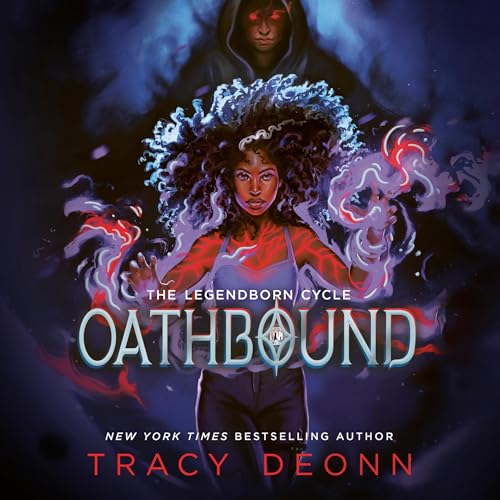
Article contains HUGE spoilers for the Legendborn series by Tracy Deonn, including Oathbound.
With the latest release of Oathbound, the third book of the Legendborn Cycle by Tracy Deonn, my mind has little room for anything else. This YA Authorian-based fantasy series is based in a contemporary world where the Legendborn, a secret society filled with descendants of King Arthur and his knights of round table, dedicate themselves to protecting the world from the Shadowborn as part of the Order. Our girl, Briana (Bree) Matthews, infiltrates the Order to find the cause of her mother’s death. Only for other shocking discoveries to greet her: that she’s the ACTUAL Scion to King Arthur—his descendant by sinister means—as well as a Rootcrafter, whose powers were passed down by her mother and their ancestor Vera. A power that can only be held by one woman in a generation. Being a black girl in a society that’s hellbent on making her feel unwelcomes, comes with various challenges and Bree had no choice but to face them head on.
The ending of Bloodmarked, the second book of the series, left Bree separated from her friends and loved ones, and in the grasp of the Shadow King (aka, the guy the Order has been trying to defeat for since Arthur and his round table crew walked the earth. The big bad.) Previously masquerading as Erebus, Leader of Kingsmage, the Shadow King had come to collect the debt that’s been plaguing Bree and her ancestors for generations. So she makes a risky gamble: she promises the Shadow King that if he trained her to grow and improve in her magical abilities, she would allow him to consume all her power in the end. Bree at this point is struggling with controlling her powers, and is willing to do ANYTHING to become unstoppable. Even if it means making a deal with the devil himself. With Oathbound, we see Bree dealing with the consequences (both intended and unintended) of her decision, as well as what the other characters are up to in the wake of her disappearance and the impending war on the horizon.
Like with the other previous books, I inhaled Oathbound in a single night (thank goodness my 10am tutorial was cancelled that week). First impressions? Five out five stars, I found myself entirely impressed by what Deonn was able to accomplish in this book, from the characters, the introduction of multi-povs, and expanding the world of Legendborn and Bree’s journey.
During her book tours, Tracy mentioned how with Oathbound she decided to play a lot with tropes. And man, did she play with them. I could talk for ages about how she subverted each one but then we’d be here all day. There is a particular trope that is a HUGE part of Bree’s character arc in Oathbound. And it just so happened to be one of my most hated tropes of all time.
Wait, what was I saying right now?
Oh right: Amnesia.
The amnesia trope is a common plot device used in many stories in various media. It usually comes in the form of a character losing some or all of their memories, and trying to bumble their way through the narrative as they figure out who they were before and how to get their memories back. As one of my favourite youtube channels, Overly Sarcastic Productions, puts it, the amnesia trope is one of the most versatile tropes there is. It can help bring in new conflict, further plot points, or serve as a starting point for interesting character exploration. Just like any trope, it can enhance or detriment a story, all depending on how it’s utilized. One of the few cases where I actually liked this trope was in the novella Piranesi, by Susanna Clark. Probably because *spoiler alert* We don’t actually know that Piranesi has amnesia until much later into the book. The anime Death Note is another example that uses the amnesia trope well; for a while Light loses his memories and sides with his archnemesis L on a case. We get to see how, in another life, these two could’ve been friends as when they’re amicable colleagues their dynamic with each other is quite complimentary.
Unfortunately, the vast majority of stories I’ve come across that have the amnesia trope, can come across lazy in their execution. It’s often used for cheap drama that barely has long lasting effects on the characters, or a plot twist ending that overall unravels the journey the character went through. It can also be used to absolve a villainous character of their wrongdoings. Also… it’s just a very overused trope. Don’t believe me? Just hop on over to TV Tropes and go crazy.
Readers of Legendborn are not unfamiliar with the use of memory loss in the series. Within the Order, a group of super soldiers called Merlins have the power to take away people’s memories. This ability is referred to as mesmer. However, we discover early on in the series that Bree is immune to such mesmering when someone ( our beloved grumpy Merlin Selwyn) tried and failed to make her forget the supernatural happenings she witnessed on her college campus. Other instances of mesmering occur throughout the series; in Legendborn, Bree is threatened by Nick’s father to leave the Legendborn, if not, he’ll mesmer her best friend Alice. Another harrowing instance is when in Bloodmarked, someone chooses to have his memories of the traumatizing events of the final battle in Legenborn taken away.
Here, we see a recurring theme around memory and how the Order uses it to control its members—and anyone who gets in the way of their plans. In Legendborn, Nick—Bree’s first companion within the Order—revealed to her that his mother was mesmered by a Merlin after she tried to take him away from the Legendborn life. In one of the most harrowing scenes of Bloodmarked, Bree is kidnapped by the Regents and forcefully interrogated—where after each interrogation she’s mesmered so each day feels like it’s the first one. To the Order, memory is a powerful tool to control the narrative it so desperately wants to maintain—that Bree isn’t Arthur’s Scion. That her ancestor wasn’t taken advantage of by Arthur’s own, giving Bree his power she now wields. Their lie extends to that their organization, in its entirety, isn’t based on white supremacist ideals where they take power. They are righteous, fair and honourable, and that’s the myth that’ll be fed.
However, with memories comes knowledge. When Bree is first getting to understand herself as a Rootcrafter, she’s taken on a memory walk showing Wildcrafters (a subset of rootcraft) taking care of a recently whipped woman by borrowing the power of plants to heal. The scene shows an alternative way to show how Legendborn uses magic. Through these memories and others shown by her ancestors, Bree learns what it means to use Rootcraft. The sacrifices her ancestor Vera made to protect Bree. And though Bree later comes to resent Vera for what she did, it’s the memories of the ones that came before her that fuels Bree to fight against the Shadowborn and the Regents. One of the main ways Bree defies them is thanks to her mesmer-resistance.
So you can only imagine my dread when I turned the fateful pages of Chapter 6 of Oathbound and realized, alongside Bree, that she cannot undo this specific mesmer. At this point, alarm bells were ringing inside my head. How will this mesmer affect her journey in this book? Will this be another bad use of the amnesia trope? But alas, I quickly learned to have faith in Deonn.
Subverting Expectations
“What can I possibly do with these remnants? What can I possibly expect to take back to those five people who elicit these emotions… If I returned, would they accept me back at all? Especially when I look at them as though they are strangers?”
Remember when I said that Bree was willing to do ANYTHING to grow her powers? Well, Erebus sure did. He saw the guilt Bree felt from failing her friends is what was preventing her from her full potential. So to the chagrin of everyone reading, he does an experiment. When Bree wakes up the next day, she knows something is wrong with her mind. She can’t recall the name, face, or personality of the person who gave her the clothes she currently wears. Or the person who desperately chased after her, before Erebus swept her away. They appear as grey mists; faceless, indistinguishable from one another. All that’s left is a single emotion connected to each of them. Guilt, shame, gratitude, compassion, love. This isn’t a mesmer– as Bree’s quickly told by Erebus—where it erases everything about the memory so you wouldn’t even know something’s missing. It’s something else entirely that seems to depart from what readers are used to regarding this trope.
The presence of some information in of itself, is an intriguing subversion of the amnesia trope. Bree is still able to remember who she is, where she came from. She remembers the events that have happened, and even the people who’ve died, such as her mom. The people she’s spent her time with up to this point aren’t forgotten figures, but rather are blank pages that she struggles to fill in the lines for. As she quickly comes to figure out, what she lacks isn’t memories, but knowledge. This emphasis of her not knowing vs. remembering is repeated throughout the rest of the book by other characters.
Through this, Bree explores new parts of herself, whilst still retaining the growth she went through in the previous books. Besides her, Erebus is also accompanied by twins Elijah and Zoelle, half-demons who work for him and have less than nice things to say about Bree starting off. But a trip down to a local bar to get info from a demon leads to them bonding. It’s here where Bree is able to remove herself, if only for a bit, from the demands of Erubus’s trainings and reevaluate parts of her identity, including her sexuality: “I watch the shifting colors of long gowns under lamplight and study the clean lines of rented tuxedos and shiny lapels. “I think… I’m into… people people”
One of my fears with this particular trope being used, is that anmesia will bring Bree several steps back in her journey when she should be taking leaps forward. A reset of her character essentially. But the presence of memories, despite not knowing the people within them, lets Bree remain the same person we’ve seen in the previous books and continue her growth however in a difficult situation. This creates a new conflict for Bree as, whilst training with Erebus, she is also trying to figure out who the people from her past are. In addition, her lack of knowledge also leads into an interesting exploration of how her lack of information is handled by surrounding characters.
Absence of Information: A Different Kind of Grief
“I knew you could grieve dead people,” I whisper “Guess I didn’t realize you could grieve living people too.”
When she confronts Erebus about what he had done to her, he throws all the events that happened at the end of Bloodmarked in her face. How she, on her own, decided to abandon her friends to train with him– their greatest enemy. How can she return to them now, and not remember a single thing about them?
Here, Deonn sets up a very interesting arc for Bree that is a mirror to her arc in Legendborn. In the first book, she dealt with her feelings of grief over the death of her mother and the shame for how she left their relationship on a bitter note. Her mother’s absence created this hole inside of Bree that begs to close up but never can. Oathbound, however, has her dealing with a different kind of grief. Being unable to recall the people who filled your life is a sort of death within itself, and the longer Bree stays and trains with Erebus, the more the emotions associated with each person lingers. The question mark that is her relations to each misty figure, is one that continues to haunt Bree as the months pass by. And Erebus takes advantage of her lack of knowledge, leaving out key info of certain events to keep Bree under his thumb. This attempt is made when Erebus confirms Bree’s unspoken suspicion that she was romantically involved with Selwyn for a time; as well as revealing that he was Kingsmage. Meaning he was more important to others than Bree herself.
“And now he is gone.” Erebus states. “Sent away to his mother, to suffer” I feel as though I’ve been physically struck. The guilt comes in new waves, reaches deeper and wider. The Merlin boy was a Kingsmage, which means he is missed in more ways than one…and I was a part of that”
However, in this same scene, Bree relies on the knowledge she does have– of a Kingsmage (that readers know to be Sewlyn’s mother) retaining her humanity despite all odds—to come to the conclusion that it’s likely that Sewlyn hasn’t actually succumbed to his demonia. It’s such a good moment as it shows that Bree isn’t totally helpless due to her memory loss. By flaunting what he knows over Bree, Erebus inadvertently gives Bree the hope she needs,
Eventually, she does meet up with the other characters while on her Erebus-sanctioned mission in Penumbra, notably Nick, who she shared a very special relationship with. Their first run-in with each other, which includes an epic romantic tension-filled fight scene that had me swooning, leads Bree to an understanding; that she shared a special relationship with this person. But she can’t even remember his name.
Yet, Nick doesn’t blame her for her lack of knowledge. Rather than looking down upon her, he adjusts and makes sure she’s able to understand just enough to get through the day. Not only that, it’s affirmed to her, multiple times, that who she is now, lack of memories and all, is more than enough. I think the most significant scene between the two is the one where he recounts their first meeting. It is one of my favourite scenes of Oathbound as it really emphasizes the connection the two share. Despite not remembering, Bree still knows the feeling behind Nick’s description of their first kiss. A moment, where they’re finishing each other’s sentences, Nick picking up where Bree’s memory falters. Her lack of knowledge is an obstacle, but it’s one she doesn’t have to face alone.
“But when I look back at Nick, he’s gazing at me as though I’m exactly who I should be. Like I am complete. Nick looks at me as if, no matter what’s been taken from me, in this moment I am more than enough. As if I am so much that I could overwhelm him if he’s not careful.”
This sense of understanding and care from Nick extends to the other characters as well. When Bree finally reunites with the rest of her Legendborn friends and Rootcraft family, the scene is so..bittersweet. Despite not knowing who they are, she still feels a sense of protection and safety from them. She learns to forgive herself for the actions she took in the previous books and realize that this hate from the others for abandoning them is unfounded.
It’s so beautiful because throughout the multi-povs we see how much Bree’s physical absence affects the rest of the characters. With Nick, who goes on an unauthorized mission to search for her, Mariah struggles to live up to the person who she considers to be a singularity. William, who reconsiders his allegiance to the Order. Through their mourning, I mourned with them. So for Bree to finally unite with them, and seeing how they take her into their arms despite not knowing who they are, made me tear up.
Because at its core, the series is about how love transforms us. How even when the thing that loved us is gone, the impact it left on us is still felt and continues to affect us long after the source. In Oathbound, exists a multitude of absences: but left in place of them are varying emotions that connect Bree to her friends. And throughout the book, she falls in love with them again. Which I think is pretty beautiful.
Tropes are usually at their best when they’re subverted in some way. Amnesia is a trope I’ve seen done countless times but Oathbound is one of the few stories that I can describe the use of it as…refreshing.. It only takes one person, to take something that one’s become bored of, and show you a different side of it. What Tracey did with the amnesia trope in furthering Bree’s journey is something I’ll take with me as both a reader and a writer.
Contributed by Adaora Olisa
 The Spectatorial
Leave a comment