Remembering Penelope Delta’s Μάγκας (1935): translation, children’s literature, and growing up
When my family picked up and moved across the Atlantic ocean, we brought our orange couch with us. It has seen better days—the decorative white seams have frayed and all but come apart, the legs are crooked, the two sections don’t quite fit together, and all manner of juicebox and ice cream stains have been concealed by a collection of artfully arranged throw pillows. I can’t remember ever having a living room without this couch inside of it; in a few months, it will be old enough to drink in Quebec, Alberta, and most European countries.
My love of books is another constant in my life that I can trace past the furthest edge of memory. For as long as my family has had a living room with an orange couch, I have wanted to immerse myself in as many stories as I can find. Before I could make sense of them myself, my parents narrated them to me—my dad with a copy of Julia Donaldson’s The Gruffalo, and my mum with an anthology of Romantic poets that went straight over my tiny head. More than pebble beaches and palm trees, more than our neighbours or my kindergarten, what I remember of Cyprus consists of the stories I was told.
Four years after moving to a country where we only heard our language at home or at church, my little sister and I sat cross-legged on our orange couch and watched our mother open a book. Between the ages of nine and fourteen (five and ten for my sister), we passed a novel around every night, taking turns reading it aloud. We read everything from historical narratives to science fiction, Twain to Verne, even Byron and Keats when we were between novels and our mum had to source something else for us to read. The only consistent rule was that it had to be in Greek.
I remember most of the translated works we read by their Greek names—I still forget that Μεγάλες Προσδοκίες is Great Expectations, and that the “D” in Don Quixote is not pronounced like a hard “th.” While I am grateful that I grew up immersed in classic literature, I am more grateful for the less world-famous books my mother eventually selected for us: those originally written in our language. The author Penelope Delta, for example, lived from 1874 to 1941, and spent those sixty-seven years moving between Alexandria, Frankfurt, and Athens. Her world was an unsettled one, her nation (Greece) struggling to govern itself, and her novels tracked this political unease. Her family’s wealthy and well-connected status meant that she often had major political figures like Eleftherios Venizelos—a statesman and eventual prime minister—in her home, and her affair with Ion Dragoumis gave her further insight into the political landscape.
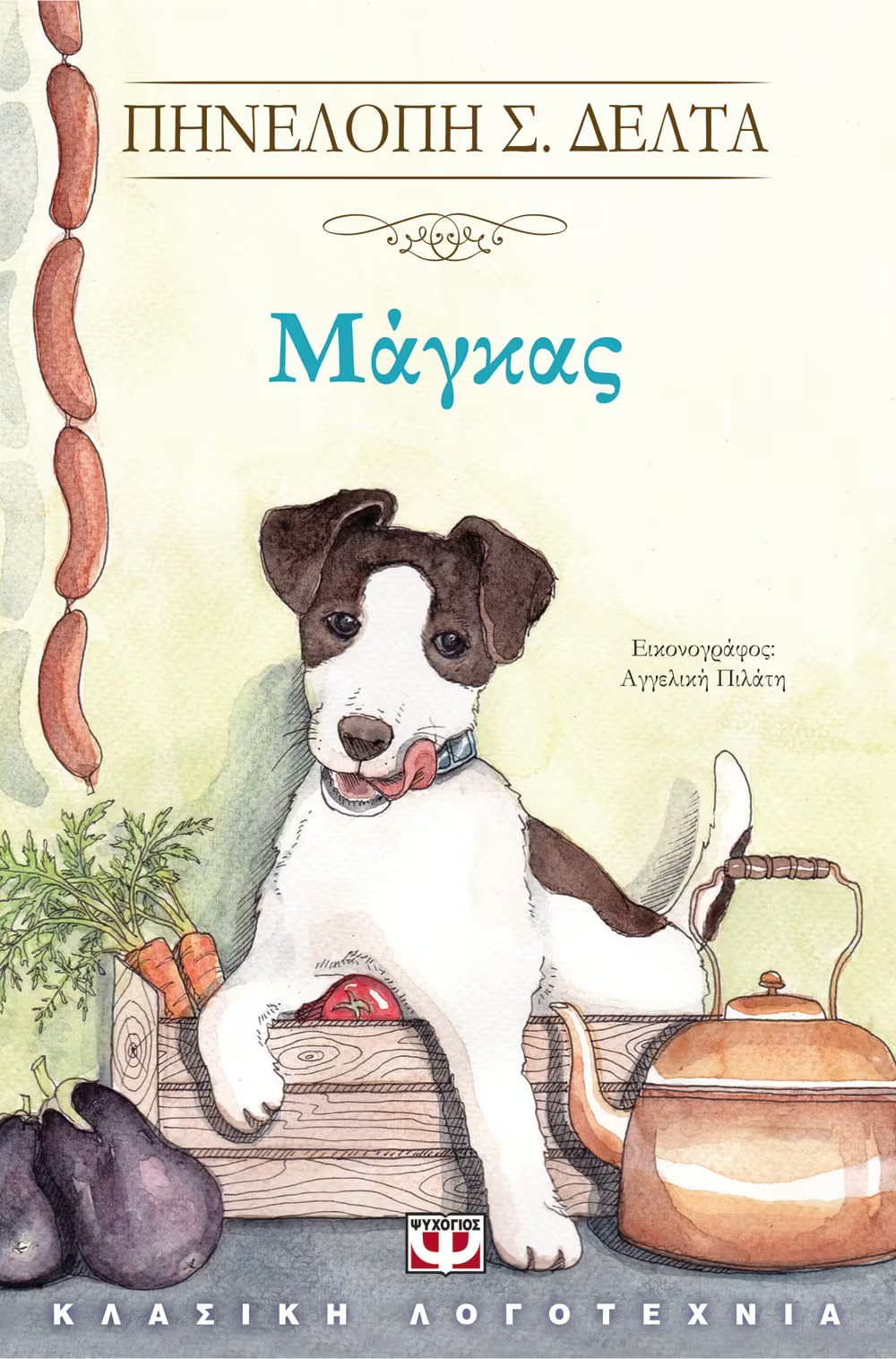
After the assassination of Dragoumis, Delta gave herself over to grief. Curiously, she wrote her most successful children’s novels during this period. The one that made my little sister laugh the most was called Μάγκας (titled after a playful but occasionally derisive term for a swaggering, overconfident young man). Published in 1935, it tells a story that leads up to the Macedonian Struggle from the perspective of a fox terrier, a pet of a rich Greek family in Alexandria inspired by Delta’s own. Μάγκας is whip-smart and mischievous, with a nose for trouble and a penchant for becoming tangled up in it. His everyday adventures within the house are contrasted starkly with his misadventures on the streets of Alexandria, where he befriends an old stray. The book culminates in his decision to accompany his master as he embarks for war in Ottoman-occupied Macedonia. Despite being a humorous novel geared towards children, it is deeply emotional—Μάγκας’s curiosity is just as unfailing as his loyalty and love.
It has been over a decade since I heard my mother’s smooth voice leading us through the story. Of all the wild hijinks, the part which comes to mind most clearly is a scene where Μάγκας chews through the armchair of a disliked uncle. This uncle protests, speaking to the others in a deeply annoying, deeply condescending, and deeply elitist form of Greek known as “Katharevousa”, or “pure language”, meant to bring what conservative figures viewed as the primitive Demotic Greek (the Greek “of the people”) closer to the more “sophisticated” ancient Greek. It was used in formal settings and public documents before Demotic Greek was made the official language again in 1976—not before it became a driving factor for shutting the lower classes out of their own public affairs. This is one of countless examples which illustrate the novel’s close relationship with its author’s political context despite its intended audience. Instead of softening the Katharevousa incident, its otherwise wholesome canine protagonist serves to alienate this linguistic purism and render it all the more ridiculous.
As a child whose attempts to preserve her understanding of her language took the form of late nights listening to her mother read this book, learning about Katharevousa enraged me. At nine or ten years old, I had a rudimentary sense that this business of language was important—my language was my world, and most of the people in my family who spoke it did so from small, rural villages divorced from the elite circles that Delta wrote about. At four years with my extended family at a great distance, I had also begun to conceive of language as a fragile thing, realising with some horror that my mother needed to correct me when I stumbled over words I had previously summoned to my tongue with ease. We didn’t read Μάγκας because it was funny or interesting, we read it so we wouldn’t forget.
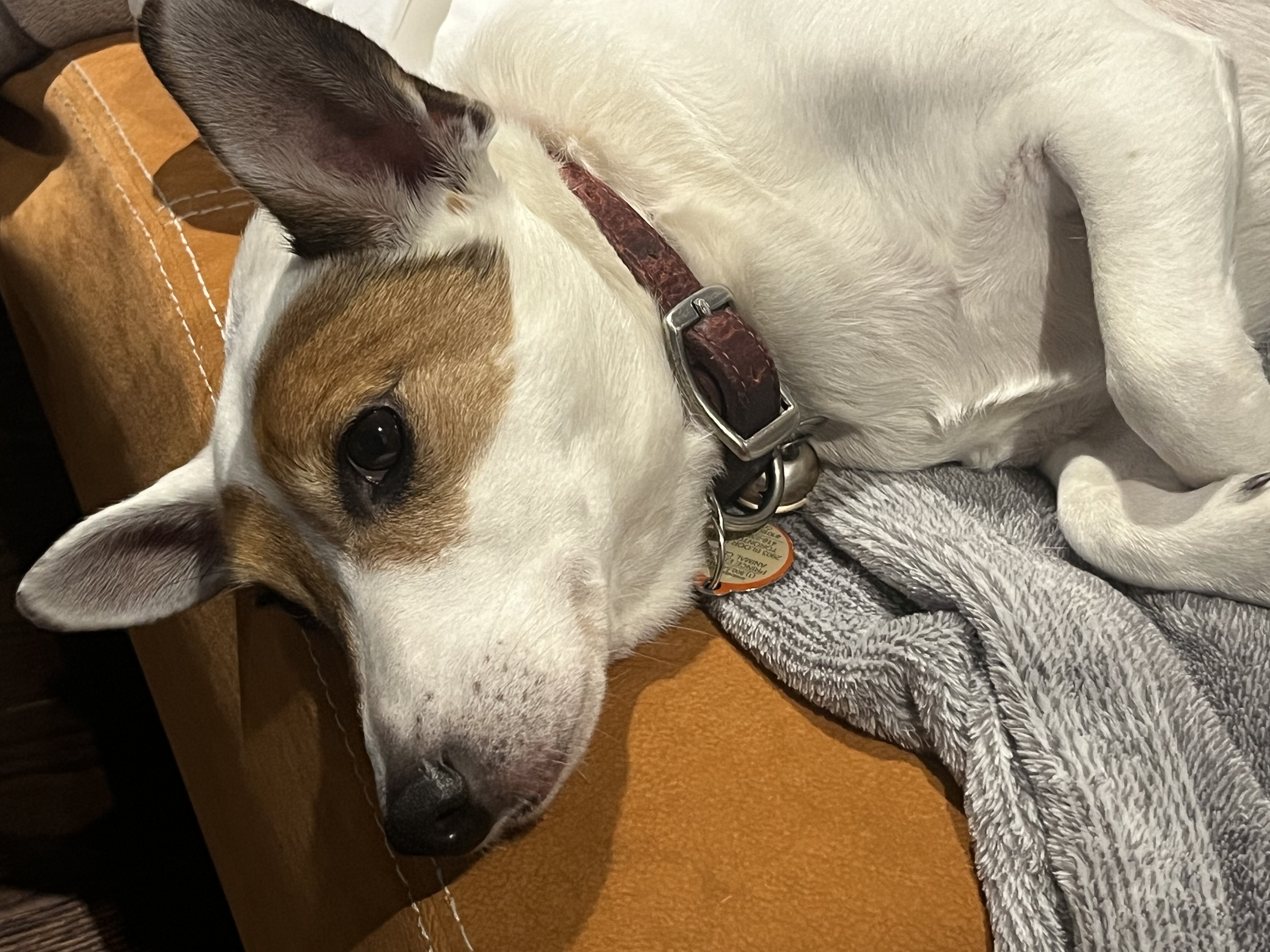
The speculative elements of the novel further highlighted this frustration and fear at the prospect of not being understood. As lively and intelligent as he seemed to us from his first-person point of view, Μάγκας was a dog, and his family had no ability to translate his indignant barking into coherent sentences. When we reread the book at a later date, I remember wanting to shout at the people on the pages to listen, despite knowing that I was no more likely to listen to my own terrier, sitting patiently beside me on the couch with his ears pricked up so as to better hear my mother’s voice.
Μάγκας’s point of view was also an avenue for mine and my sister’s education. Our mother was hardly going to read to us from a textbook—although Delta’s biases and perspectives as an aristocrat were far removed from the way our ancestors might have understood their political context, we absorbed knowledge about our history by reading children’s fiction like this. Eight thousand kilometres away from where we came from, these books formed a bridge between our orange couch and the rocky blue shores we remembered.
I turn twenty in just over a month. Even now, I think of Μάγκας as I sacrifice sleep in favour of squinting at ancient Greek verbs in Classical texts, studying words shaped by the same letters Penelope Delta committed to paper two thousand years after Plato sent a fictionalised Alcibiades careening into a symposium. I turn my coursework into an act of preservation—when my aunt texts me in Greek, I struggle less to decipher the written form of the language that I let stagnate between the last time I let my mother read to me and the beginning of university.
Reflecting as I somewhat clumsily navigate young adulthood, I find an unexpected joy contained in this story by a grieving author who would one day end her own life as German troops entered Athens. My recollection of it is suffused with my sister’s laughter, my father’s voice reminding my mother that we had school the next day, and her subsequent promise of “one more chapter.” When I have kids of my own, I will make them the same promise—we will pass a book around, maybe even this one, and I will teach them to remember.
Contributed by Phoebe Sozou
 The Spectatorial
Leave a comment