
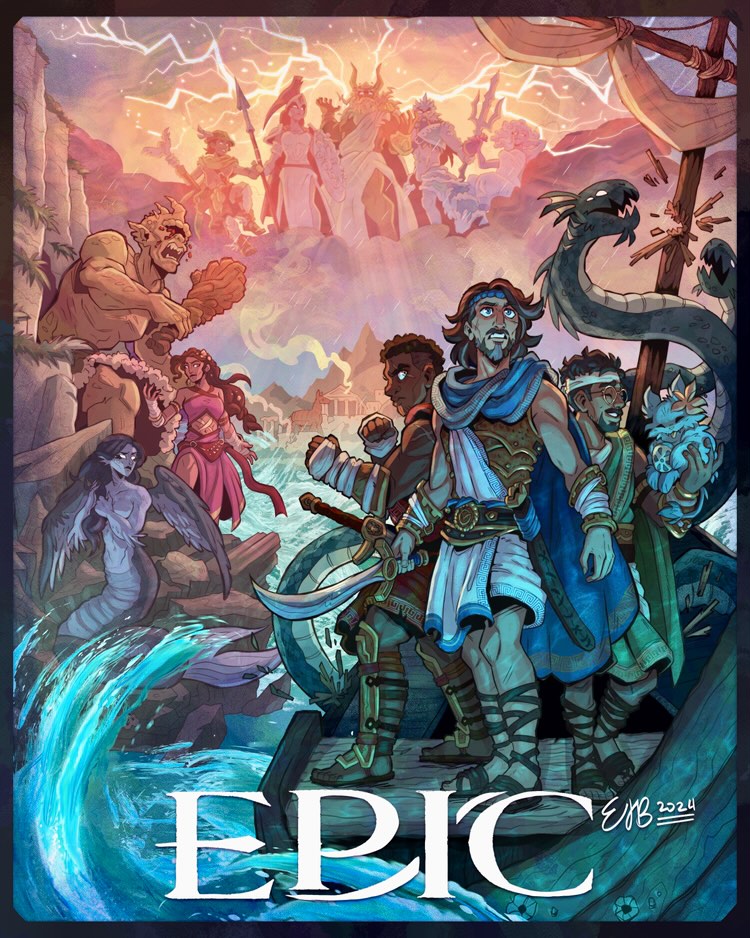
Featured image credits to @ethanillustrations on Instagram.
Made by Jorge Rivera-Herrans, Epic: the Musical is a two act adaptation of Homer’s The Odyssey, which combines his knowledge of musical writing and a cast of talented singers to add a fresh twist on the classic epic poem. I’ve been in many fandoms throughout my life on sites like Tumblr: Steven Universe, Undertale, various animes, etc. However, within each of these medias, the original media was made first, and then the fandom followed. Epic does not follow this same formula since it both lacks an official visual adaptation and developed alongside its fandom. Jorge released the musical in a series of sagas, each coming out months after one another, allowing the fandom to grow just as the musical itself did. However, previous popular musicals like Hamilton and Heathers often debuted in the form of a stage play. If fans wished to create their own works like fanart or animatics based on these musicals, the visuals of the works had to resemble that of the official visuals. Epic exists just as its songs with no singular official visual version. Jorge’s decision to not have one single official animation (as of writing this) shows how by allowing fans to contribute to the world and characters, the fandom is encouraged and self-sustained. As a result, Epic is able to remain fresh in people’s minds and also allow fans to bond with the creator as much as with each other.
By prompting fans to create within a fandom through lack of visuals, Epic is able to remain in public interest for longer because it can “feed” — an online term meaning to be given new content — itself in diverse ways. In most media like TV shows and movies, fans rely on content from that original media to be fed. Their appetite puts strain on the original creators due to needing to keep up with the increasing demand lest interest in that media die down. In Epic, because there is no singular official visual medium, any animatic or visual media fans create inherently fills that niche within the fandom’s demands. Although Jorge does have a vision for Epic, he does not restrict this vision to a single art style or artist. Instead, all of the “canon” visual media for Epic comes from him commissioning different fans to work on different songs and scenes. Even then, fans often do not try to emulate the “canon” version. Fans develop their own artstyle and interpretation of characters/plot points in the musical. For example, in the song “God Games,” the goddess Athena argues with the other gods in an attempt to convince them to release Odysseus from imprisonment on Calypso’s island. There are many different fans who interpret the visuals of this song in different ways. In one version of the song, popular artist Gigi (gigi2820 on youtube) portrays the confrontations are simple arguments but in Neal Illustrators’ (nealillustrator on youtube) version, each argument occurs during combat. Because both animatics use a completely different vibe in the song, they are able to satisfy the fanbase in similar yet unique ways. Jorge’s implicit encouragement of fan creations allows Epic: the Musical fans to create content for each other in diverse ways that satisfy the lack of visuals in the original media.
By holding space for his fans to be creative and allowing fans to be creators too, Jorge also allows a closer bond between himself and his fans and a parallel creating process. He crowd-sourced donations he got from streaming his songs and in return, commissioned a diverse array of artists to make the visuals for the songs. Both of these interactions reflect the cyclical nature of Epic’s creative process. Fans fund Jorge’s endeavors through streaming and word of mouth marketing and Jorge funds the fans’ endeavors through commissions and providing a platform for fan artists. This symbiotic relationship between fans and Jorge has always been a part of Jorge’s work for Epic. Back in 2022, Jorge held auditions for the musical on TikTok through duets. From these duets, Jorge was able to cast people passionate for music and even some established musical artists like Steven Rodriguez and Torontonian indie-pop boy, MICO ( credited on Epic with his actual name, Miguel Veloso). Jorge is able to create an upward cycle where fans fund his work and vice versa by encouraging fans to create their own interpretations of his work.
Despite Jorge not creating a single official visual medium for Epic, there are many visual elements he requested when commissioning artists. One of these elements was that Odysseus’ dog, Argos, should appear in Telemachus’ solo song, Legendary, then never appear in the musical again. This is a reference to how Argos dies in the original epic shortly after the audience meets him. Another is how many fans will draw Polites wearing glasses as a nod to his voice actor, Steven Dookie, wearing glasses in real life. Jorge sprinkles in a lot of these other easter eggs in how he imagines the visuals such as Eurylochus’ big sword being a reference to Guts from Berserk/Cloud Strife from Final Fantasy 7 or how Odysseus and Circe command monsters to fight the other like Yu-gi-oh or Pokemon. Each of these specific visuals are made with allusions in mind. Even though each of these visuals are technically canon, they still exist as an indicator of the relationship between fan bases and creators; Jorge requested these visuals as allusions to stuff in his life whether that be the people he worked with or media he liked. Despite being a creator, things he is a fan of makes its way into what he created.
Jorge’s Epic: the Musical’s wide fandom is based on Jorge’s encouragement of fans to create their own art based on his. From this model, he is able to allow fans to create content for each other while also creating a cyclical nature between himself and fans where fans fund Epic and he funds and platforms fan artists. Most of the other media I consume maintain a level of distance from their fan bases no matter how outgoing the creator is in interacting with fans due to the development of the media taking place independently of fans. I have seen plenty of other animatics for musicals, like Satisfied for Hamilton, but those works often needed some basis in the actual canon, restricting creative freedom. But with Epic, Jorge welcomes the diverse array of interpretations of his songs, giving fans the space to be creative within the media they love. While many other entertainment corporations view their fans as simple consumers, Jorge always strives to maintain a close relationship with his fans.
Contributed by Nathan Agustin
 The Spectatorial
Leave a comment