
Jade City is a gripping Godfather-esque saga of intergenerational blood feuds, vicious politics, magic, and kungfu. The Kaul family is one of two crime syndicates that control the island of Kekon. It’s the only place in the world that produces rare magical jade, which grants those with the right training and heritage superhuman abilities. The Green Bone clans of honourable jade-wearing warriors once protected the island from foreign invasion–but nowadays, in a bustling post-war metropolis full of fast cars and foreign money, Green Bone families like the Kauls are primarily involved in commerce, construction, and the everyday upkeep of the districts under their protection. When the simmering tension between the Kauls and their greatest rivals erupts into open violence in the streets, the outcome of this clan war will determine the fate of all Green Bones and the future of Kekon itself.” As the Goodreads summary reports, the Green Bone Saga is an incredible series that follows the many ups and downs that the Kaul family faces while defending their clan in Kekon. In my opinion, Fonda Lee has crafted a perfect fantasy series through her extensive world-building and complex characterization, and I am going to tell you why every fantasy lover should read it.
The plot of this series is well-paced with a good distribution of action, political intrigue, and personal relationships. This balance allows for the reader to understand the world and the characters deeply, while also being sucked into the simmering tension that could erupt at any moment. When it comes to the politics of this world, the reader is thrust into an existing order. As the books progress, we come to understand the dynamics between certain groups and people. Fonda Lee approaches this task effectively; there is some exposition, but much of the drama is revealed through action as well. I appreciate this tactic as it allows the audience to read situations on their own rather than relying on info-dumping. The political dynamics are complicated and interwoven; significant portions of the novels are dedicated to developing this system. It can feel slow at times, and you must be careful to pay attention; however, it is incredibly rewarding when numerous plot threads come together and result in a multi-layered climax.
Like the political intrigue, the action in this series is perfectly executed. As a fantasy-lover, I always struggle with action in books. I find that it often feels drawn out, and I begin to disengage from the novel I’m reading. That is not the case with the Green Bone Saga. The action in these books is dynamic, exciting, and devastating. Often, the fights are smaller in scale because it is clan/urban warfare rather than a full-scale battle. This smaller arena means that each fight involves characters you have formed deep attachments to, and Fonda Lee does not shy away from including tangible consequences in her books. Additionally, each fight or action sequence is the culmination of tension that has been building up for a long time. This tension raises the stakes even more as the reader fully grasps the importance of each battle. It also helps that each confrontation is written incredibly well; you can picture these characters fighting move-by-move. Jade as a weapon and tool is developed thoroughly as well. This development is important because the firmness of the magic system grounds the action. The reader knows what is and isn’t possible for the characters because we see them train and develop their jade abilities. Fonda Lee does not play fast and loose with the rules of jade; the ways it can be used are consistent and that allows us to be invested because we know the potential outcomes of jade use.
As much as I appreciate the world and plot of the Green Bone Saga, my favourite aspect of the series is the characters. Fonda Lee writes her characters masterfully; each one is well developed with numerous strengths and flaws. There are four key characters in the first book, each one an integral part of the Kaul family. At the head of the No Peak clan, we have Kaul Lanshinwan. Lan is the eldest brother of the Kaul siblings; he is the steady one who leads the clan responsibly during peacetime. In some books, he would be easily reduced to the wise older brother who can always be depended on. However, the reader quickly sees the cracks in his armour. Lan’s wife left him, he is not able to handle his jade as well as he should, and people are starting to question his abilities to lead the clan if war breaks out. On one hand, Lan seems like the ideal leader, strong and steady, but we can also see him buckling under the mounting pressure. Next, there is the Horn of No Peak (i.e., the head of military affairs), Kaul Hiloshudon. The reader quickly perceives Hilo as a hothead who cannot control his temper. Again, a character like Hilo could easily be reduced to the stereotypical hyper-masculine bully. He does fit that description in some ways, but he is also the most emotionally vulnerable and open character in these books. Hilo feels everything deeply; this means that he erupts in an overdramatic fashion regularly, but he also passionately loves his family and friends. He is fiercely loyal and compassionate, but he is also punishing and cruel in his judgement. Hilo is somehow both the most frustrating and the most loveable character in the series. The last Kaul sibling (and my favourite character of the series) is Kaul Shaelinsan. Shae was the star of the Kaul family growing up as she had to work harder than her brothers with the disadvantages of being a woman and being the youngest. However, when she graduated, she decided to move to another continent, abandoning the clan and disgracing her family. Throughout the first book, we see her come back to Kekon and grapple with trying to maintain distance from the family but also wanting to be part of the clan again. Shae is hard-working, determined, and incredibly stubborn. She struggles to show her family that she loves them because she has such ambivalent feelings about the clan. While she worked hard to escape the family obligations and create a life for herself outside of the clan, she also recognizes the strengths and value she would bring to the clan if she came back into the fold.

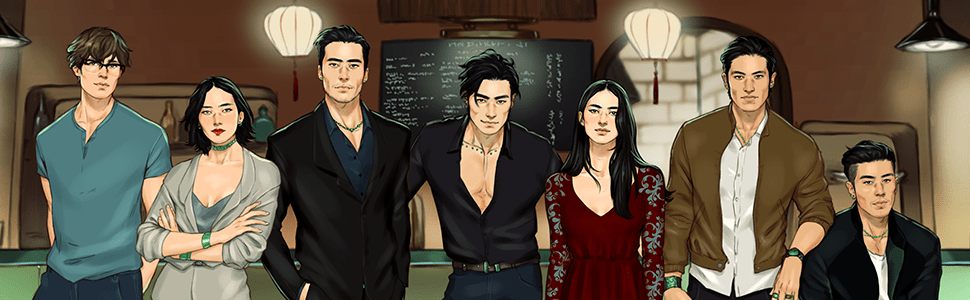
(From left to right: Emery Anden, Kaul Shaelinsan, Kaul Lanshinwan, Kaul Hiloshudon, Maik Wenruxian, Maik Kehnugo, Maik Tarmingu)
Shae, as a character, also brings me to another aspect of this series that I love; Fonda Lee portrays women as real, complex people in this series, which is refreshing for fantasy. As a long-standing fan of the genre, I know the typical representations of women. There are a few roles that women in fantasy fall into; some include the tomboy girl who loves to fight and becomes masculine in proving herself, the beautiful woman who is ultimately just a love interest and has no real personality of her own, and the smart woman who orchestrates things behind the scenes but has no role in the action. Fonda Lee takes these troops and turns them on their head. Shae, for example, is smart and that is obvious as soon as we meet her. However, she does not simply work behind the scenes. We learn that she was also an incredible fighter, the best in her class. She was never a sidekick or someone pulling the strings behind the scenes, she was the Kaul family’s shining star. Likewise, Ayt Madashi, the leader of the opposing Mountain Clan, could fall into the stereotype of the woman who rejects her femininity to become more respected. She is undoubtedly the “villain” in this series. Ayt Mada killed every man in her family so she could come to power. She is ruthless, but we also hear from her perspective in the book. She recognized that a woman could not be the leader of the clan if she did not demonstrate that she was the most powerful person in Kekon. Lan, the head of No Peak, never would have had to prove himself in that way. By bringing complexity to her character, Fonda Lee manages to make the reader understand the actions of our primary antagonist in the novels. Finally, Lee also effectively breaks down tropes with Hilo’s love interest, Maik Wenruxian. Wen could easily fall to the side in this series; she is unable to fight because she is a stone-eye (someone who cannot wield jade but is from a jade family) and her main role in the first novel is being Hilo’s girlfriend. However, Wen is not a simple character. Like the other women in the series, she is ambitious and wants to be part of the clan. Throughout the series, we see her actively take charge of situations, often at the cost of her relationships. This aspect of her character creates depth. Wen is her own person, not just the object of a different character’s affection. Of course, many amazing characters are introduced throughout the series, but these ones give you the highlights.
In my opinion, the Green Bone Saga is unmatched by any other fantasy series that I have read. Fonda Lee has created a robust world, realistic characters, and a heart-breaking but rewarding story in the course of this trilogy.
Also check out my carefully curated Jade City playlist on Spotify if you like your music to fit the mood of what you’re reading.
Contributed by Jeanne Polochansky
 The Spectatorial
Leave a comment