

In a genre known for tough guys eager to duke it out for the sake of it, drawn-out tactical fights that can last episodes, power-levels, and edge-lords, the acts of love and understanding which denote Hunter x Hunter’s (2011) narrative climaxes seem somewhat out of place. As a shonen anime, Hunter x Hunter has a peculiar focus on hearts. By hearts, I mean visceral blood-pumping organs as well as emotions that are commonly associated as “coming from the heart,” such as friendship, love, and empathy. By peculiar, I don’t mean to suggest that this focus was awkward–in fact, I found that it enhanced the show and refreshed an otherwise over-done genre. Having hearts allows Hunter x Hunter to be a show that is still about tough characters and awesome battles, but with an added emotional depth that shatters the preconceived notions of what a shonen should be in order to create characters who seem more like people caught up in dangerous situations, rather than heroes versus villains. Let’s take a look at a few of these heart-pumping moments to get an idea of what I mean.
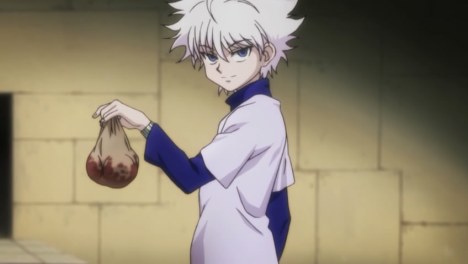
When organic hearts appear in Hunter x Hunter, they are always near the end of brutal fight scenes that often leave me doubting the morals of the ‘good’ characters I had so eagerly supported. The first of these pits Killua, a punkish thirteen year-old skater boy, against the convicted mass-murderer Johness, known for taking pleasure in ripping his victims apart with his bare-hands. Killua ends the fight before it begins, ripping Johness’s beating heart from his chest. This not only leads to the revelation that Killua comes from an infamous family of assassins, but also that his moral compass, at first assumed to be aligned with that of his life-loving best-friend – and series protagonist – Gon Freecs, is far more cold and sinister.
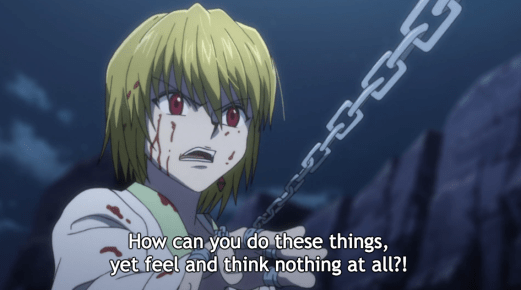
Similarly, Kurapika, the calm and collected thinker of the main group of characters, goes berserk when faced with Uvogin, a member of the Phantom Troupe – the gang of thieves who committed the genocide of his entire clan. In another extremely one-sided fight, Kurapika decimates Uvogin, rupturing the thief’s heart with his magical chain when the latter refuses to betray his closest friends. Moments like these reveal a darker side to characters who are, in more peaceful situations, friendly, and kind. This theme of grey morality, that the heroes of the show are capable of villainous actions, and that the villains are capable of being heroic, carries on throughout the show.
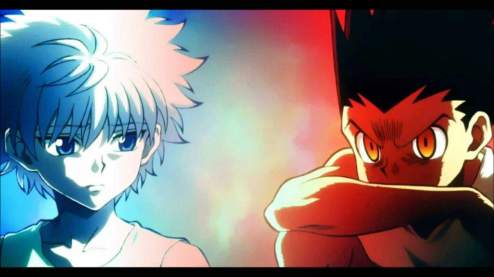
Hunter x Hunter shows that the interchangeability of good and evil are a result of the opening or the closing of one’s heart. When Gon murders Neferpitou out of vengeance, Killua is saddened to witness his friend’s monstrous actions.
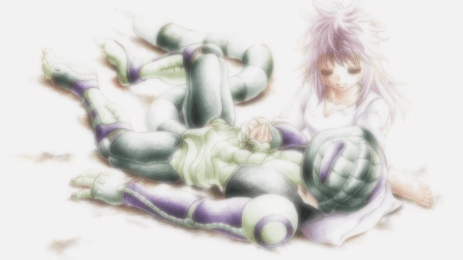
On the other hand, the antagonist of the show’s longest arc, Meruem, chooses to halt his plans for world domination in order to spend his last moments with the one he loves.
These themes come to a head in the show’s final arc as Killua and Alluka confront their older brother Illumi. Whereas Illumi sees Alluka’s god-like powers as a weapon to be used, Killua sees Alluka as nothing other than his sister. Prior to the confrontation, it is established that Illumis believes Alluka’s powers can only be activated upon granting a series of her requests. This is shown to be incorrect when Killua simply asks Alluka to send Illumi away, and she does. What this suggests is that trying to logically identify and to establish reasonable methods to activate Alluka’s power is futile because there is none. All she needed was the same love given to the rest of her siblings, all she needed was someone willing to open their heart and accept her wholly.
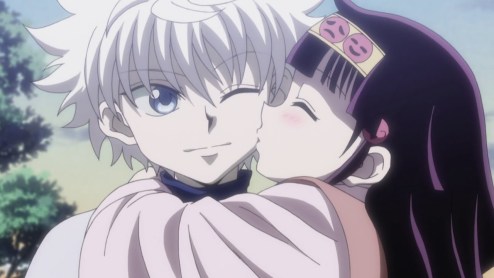
All of this is not to say that Hunter x Hunter throws out what makes it shonen in favour of a cliched “love conquers all” narrative. It’s more complicated than that. Hunter x Hunter is unabashedly shonen, it revels in its archetypes just as much as it subverts its tropes. But, Yoshirio Togashi’s decision to tell a story where a character’s feelings are more important than their power-level allows his characters to be less like talking anime chess pieces with unique abilities, and more like people. His characters are allowed to become individuals whose personal thoughts and emotions transcend their heroic or villainous roles within the narrative. Because of this, Togashi’s story has a level of character depth and unpredictability that I have a hard time finding elsewhere within the shonen genre. The tension that comes from fights are no longer about who is going to win and how, but rather how the consequences of violent confrontations will haunt the participants, and, through them, affect those they love most. Good versus evil doesn’t quite vanish, rather they get stripped down to what they really are: people versus people. In Hunter x Hunter, anyone can be a hero, or a monster. All it takes is a change of heart.
Contributed by Lawrence Stewen
 The Spectatorial