
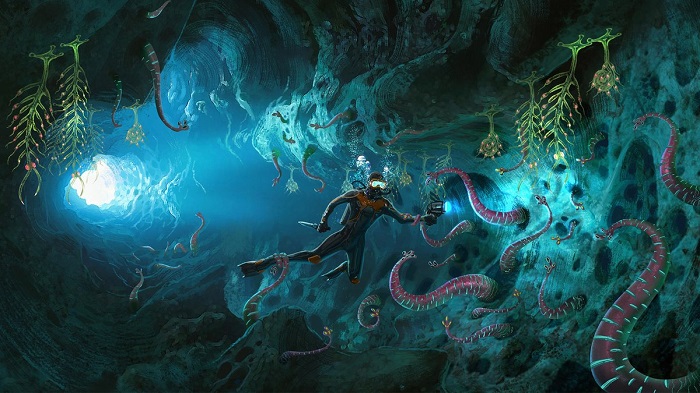
Like most survival video-games, Subnautica’s main premise is straightforward: you have crash-landed your spaceship on an alien planet. You have naught but your wits and the equipment on your landing pod to help you survive (think Robinson Crusoe in a futuristic alien world). Your main goal is to find food, fresh water, and shelter until you can find a way to get back home. Simple, right? Well, maybe not so much. I don’t mean that the gameplay is harder than it looks, but that the seemingly basic premise of the game is actually more complex than it seems. Right from the start, Subnautica presents you with two fundamental points about human survival: what you need to do vs. what you can do.
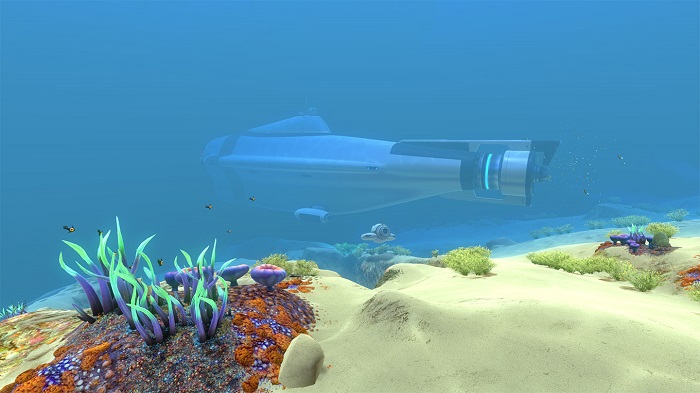
In the beginning of the game, this seems like a fairly easy choice. You need to find food and water to survive, so you craft a little hunting knife out of natural materials and go hunting. This action is clearly necessary, seeing as you would starve and die in the game if you didn’t hunt. However, as Subnautica progresses, the necessity of your actions becomes more and more questionable. Once you have your bare necessities covered, you can start acting arbitrarily, first crafting small things to make life easier (like the Seaglide which helps you swim faster), and then moving onto larger vehicles such as the Seamoth, and eventually gargantuan vehicles such as the Cyclops. What’s interesting about Subnautica is the subtlety with which it offers the player these options: it starts with little convenient tools that make surviving easier, and then moves onto larger, completely arbitrary structures. We as players are slowly conditioned to think in a way that goes from “A Seaglide will make swimming easier, surely I am justified in making that,” to “Hey, wouldn’t it be awesome having a giant submarine all to myself?”
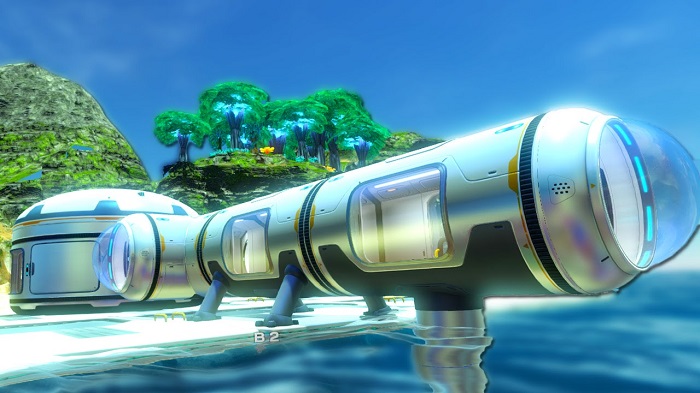
YouTuber jacksepticeye says in one of his Subnautica videos that humans don’t just kill the thing that’s in our way; we go the long way around and make it go extinct. It’s a joke, but it’s one that rings painfully true given our history of colonialism, imperialism, and eco-terrorism. The game thus gives you the choice to either become a person who takes from the environment with no regard for the consequences, or someone who lives comfortably while being conscious of their impact. Take jacksepticeye’s playthrough, for instance. At first, he just makes a small base for himself, even saying himself that he doesn’t want to change the environment too much. Later on, however, he essentially builds himself a small underwater city, complete with empty skyscrapers and an aquarium. He even makes a little amusement park on one of the islands in the game—and if that isn’t claiming a space as your own, nothing is.
The game developers themselves show an awareness of the player’s impact on the environment. When you first land in your starting area in the ocean, there are plenty of fish around that you can catch and eat. However, as the game progresses and you go fishing for food more and more often, the amount of fish available in that area dramatically decreases, and you end up having to go to new areas to find food. Now, this might just be the game increasing in difficulty to prompt the player to explore more, but in a game so detailed that the developers programmed your landing pod to gradually float away from its original position, it isn’t too far fetched to think they would also show the impact of your fishing on the marine ecosystem.
It’s also clear that humans are not at the top of the food chain in this ecosystem, nor are we meant to be. In fact, the only thing in the game that can cause any actual direct harm is a small hunting knife; almost every other handheld tool is either used for everyday convenience, or to affect the way something moves towards or away from you. Clearly, you are not meant to harm every creature you see. Subnautica is primarily a survival game, not a fighting one, and the developers stick to this principle.
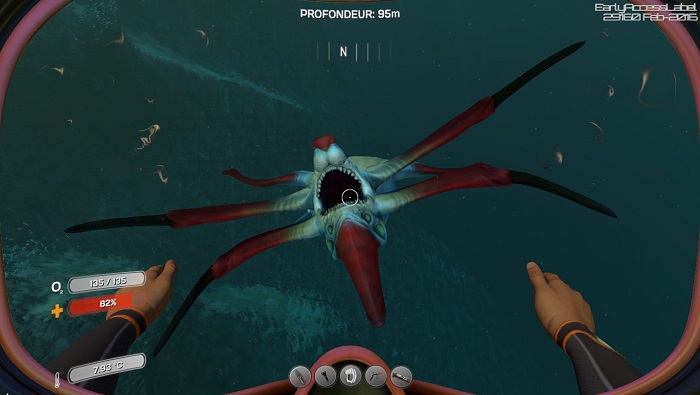
By making it so difficult to harm anything larger than a medium sized fish, the game suggests that you are only supposed to kill that which you need to survive, leaving the larger creatures well enough alone—which of course doesn’t stop any of us from trying to kill a large Stalker or Reaper Leviathan. That’s kind of the point though; going after creatures bigger than you is an illogical yet conscious decision. It requires that you want to kill not for survival, but for sport. More importantly, it demands that you take personal responsibility for harming another organism purely out of enjoyment.
This is why I think Subnautica has a much deeper meaning than what people might initially see: it shows how easy it can be, even for a decent, ordinary person, to let a conquest for personal gain or enjoyment cloud their judgment. Humanity has a tendency to claim any space we come across as our own, and we do so with little regard as to how we might affect the environment around us. As a result, humans are not the ones struggling to survive anymore; it’s everything else on the planet. We see examples of this everywhere we go: condos built where parks used to be, increasingly hot summers breaking a new record every year, invasive species choking out our indigenous ones. We see the detrimental impact our consumption has had on the environment, yet most of us still carry on with our usual lives. This passivity may be the most harmful thing of all. In doing nothing, we are forgetting one fundamental truth about human existence on this planet: our ability to thrive on Earth comes at the cost of the Earth itself.
So, yes: Subnautica is just a game. But it’s a game that says a lot about how easily humans can claim spaces as their own, and how our choices impact the world. It’s the choices we make as the player that show how aware we are of the environment. The game itself doesn’t force players to build a gigantic base to progress, nor do we need to go kill larger creatures to survive. It merely presents these options to us, and we, the players, decide what we build and how we use it. While many of us might be quick to claim that we would never willingly do anything to harm the environment, the fact is that we already have. Anyone can play this game, anyone can impact the environment, and anyone can move on without a second thought. The only question is, will you?
-Contributed by Carine Lee
 The Spectatorial