
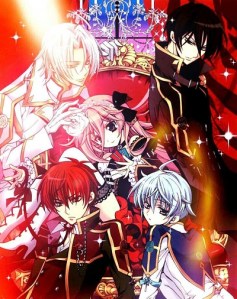
Guilty pleasures come in all categories—food, books, and TV shows, to name a few. But none of these are as quirky as manga, which can be sweet, ridiculous, and moving all at the same time. The most unusual of these is probably the “harem” genre. Similar to otome games, the genre commonly follows a protagonist surrounded by a group of attractive characters who each fit a specific archetype. The plot of the story is usually secondary to the romance, with the main question being: who will they choose?
Though the genre is quite popular in Japan, it can seem unusual to North American readers, even coming across as creepy to some. But that didn’t stop the official English translation and publication of one of my favourite manga—Shouto Aya’s Kiss of the Rose Princess.
Yes, the title already leaves quite the impression, and the covers might make it a challenge to read in public. Underneath the glittery exterior, however, lies a story that isn’t as simple as it seems.
The series follows high school student Anise Yamamoto, who is hounded for breaking the school’s uniform policy through the minute yet rebellious act of wearing a rose choker. The rest of the students seem to think she does this in order to break rules, but the reality lies in the fact that Anise cannot take the choker off. She has worn it from a young age, when her father tied it around her neck with the ominous instruction to never take it off, or else a terrible punishment would befall her. When the choker ends up being ripped off by the strange bat/cat-like creature Ninufa, Anise finds the “punishment” to be a little different than she had feared.

Anise learns that she is, in fact, a Rose Princess. She possesses four magical cards which, when kissed, each summon a different Rose Knight: the Red Rose, Kaeda, a classmate of hers whom Anise had dismissed and teased; the White Rose, Mitsuru, a third-year and popular student council president with a pervy side; the Black Rose, Mutsuki, an ancient creature known as a Dark Stalker; and the Blue Rose, Seiran, an artificial rose who is nonetheless trying hard to prove his worth as a knight.
Together, they learn that the seal on the Demon Lord has been weakened, and the five must embark upon a series of adventures in order keep the seal from breaking. In the process, Anise must make a “true bond” with a knight, ultimately resulting in a romantic relationship.
All of the above are merely the bones to the actual story. It is only upon going further into the series that the smaller nuances begin to show up. These details bring Kiss of the Rose Princess from a simple romance-heavy series to one that touches upon topics of acceptance and authenticity. The Fake Rose Princess, Ella, has four Fake Rose Knights: Purple, Gray, Gold, and Silver. Along with the Orange and Lime roses, Idel and Yako, these characters embody the strong desire for the fulfillment of a personal wish; a desire so strong that people often go to great lengths—and sacrifice much—in order to achieve it. Anise’s father Schwarz exemplifies the endless internal debate between scientific curiosity and morality.
The series has so much to cover that its only real shortcoming is the fact that it was only nine volumes long, leaving quite a few threads dangling and making the story feel rushed. The plot-line about collecting the Arcana cards and restoring the demon seal is abandoned without a fully satisfactory replacement or explanation. Some of the characters also felt like they could’ve had some more development and a couple more scenes added to focus on them, in particular the relationship between the Orange and Lime roses. I felt that there was more to it than simply a friendship and a complex past of growing up together in a foster home, and it would have been nice to see that explored.

The knight Anise “ends up with” isn’t entirely a surprise, the same way that it is frequently apparent which character the protagonist is leaning more towards in love triangles/squares in TV shows and books, and the incomplete feeling of the final volume does make it the weakest in the series. But the art is absolutely gorgeous. This is one of the reasons why I (somehow) came across this manga years ago and read it when it had only been scanned and translated by online volunteer groups, with no sign that it would one day be officially licensed in English.
The series has its fair share of adorable, hilarious, awkward, and sweet moments, all well-dispersed through each book. It shouldn’t be discredited or overlooked simply due to its sugary title or covers. It’s easy to root for Anise, and her strength and obliviousness give her character an authenticity that makes her the most balanced representation of an adolescent girl I have seen so far.
-Contributed by Margaryta Golovchenko
 The Spectatorial