
Warnings: spoilers for Game of Thrones (up to mid season 4); discussions of sexual violence, rape.
I cannot count the number of times a Game of Thrones enthusiast has told me to read the books. And now, four seasons and three books in on my personal mission to complete the series, I’m glad I have.
I understand where the hesitation for most fans comes from. Both the individual books of A Song of Ice and Fire (which will henceforth go by ASoIaF) and the series itself are enormous. The cast is just as large, and everyone—from the main character to their cousin six times removed—has a name and a story. It’s a double-edged sword, and you will either love it or hate it depending on how much you enjoy the onerous task of world-building. However, despite this, it has a magnificent sense of continuity. Character arcs make sense. Events and people parallel one another. And should there ever be extraneous detail, it is only there to enhance your appreciation of the world.
There are difficult themes in the series, but they serve a purpose. They make a point. And, most importantly, careful reading shows that George R. R. Martin is acutely aware of how these themes are framed within the narrative.
ASoIaF’s treatment of sexual violence is not for shock and awe. The world George R. R. Martin has created is misogynistic, but it refuses to be glamorized for an audience’s consumption. The storytelling clearly frowns upon women being unnecessarily sexualized in unjustified scenes of nudity and sex as well as violence against their person.
George R. R. Martin portrays sexual violence as a strategic crime against humanity: rape is used as a weapon of war. It is not there to be gratuitous. Sex scenes within ASoIaF are either a) consensual; or b) clearly rape, in which case they are played out in a negative light. Book to book, George R. R. Martin writes character perspectives that confirm this: Daenerys is mortified when the Dothraki mass rape the women of conquered villages; Oberyn Martell hunts down the brutal rapist and murderer of his sister, who also killed his nephew; even Jaime Lannister condemns rape and protects Brienne from it.
But this is where the show deviates. Unlike its textual counterpart, HBO’s Game of Thrones uses sexual violence as a tool of commodification. It seeks out the shock factor like no other show; gendered body horror is their guaranteed answer to a darker, grittier season, so where there is none, they fabricate some.
GoT has made a few significant breaks from its source throughout the four seasons that have aired. It has killed characters that do not die in the books, created characters that do not exist in the books, and eliminated key characters that do. Ros, who was a prostitute often hired by Theon Greyjoy in season one, and who worked for Petyr Baelish in seasons two and three, was created just for the show. She was smart, cunning, and, in the third season, violently murdered as a result of Joffrey’s sexual sadism. It is not coincidental that she was shot, among other places, in the groin and breast.
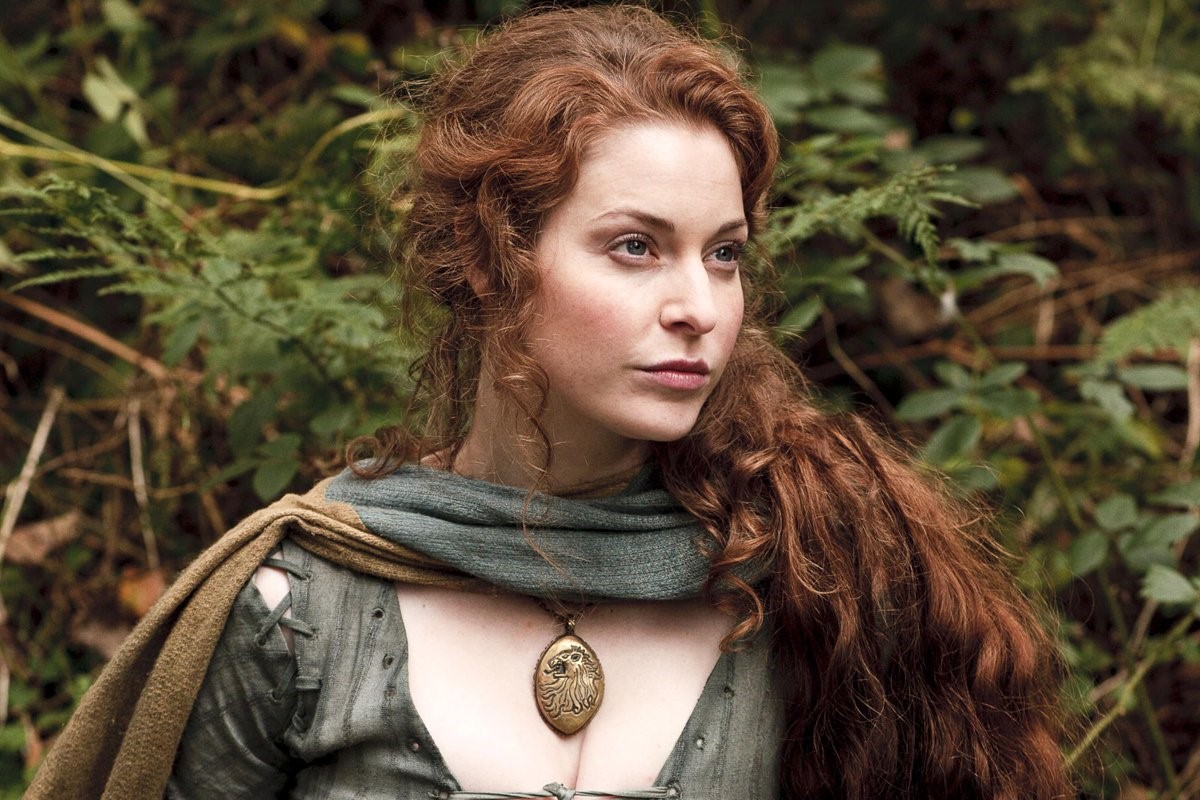
Ros in season one
Talisa Stark is another victim of graphic violence—the likes of which do not exist in the books—used against a body that is specifically female. The show portrays her as being pregnant with Robb Stark’s child on the night of the Red Wedding, most likely to increase the tragedy of her murder, wherein she is stabbed in the womb to death. Firstly, Talisa replaces the character Jeyne Westerling from the books, who is never pregnant with Robb’s child. Secondly, Jeyne does not die; she does not even attend the wedding.
Characters like Ros and Talisa demonstrate that the GoT show is not beyond adding additional gendered torture to women; or in the case of Cersei Lannister, warping an already disturbing scene into one of rape. Following the death of her son, King Joffrey, Cersei is in the sept mourning his body when Jaime enters to speak with her. The pair argues, and Jaime ends the discussion seething, asking, “Why have the gods made me love a hateful woman?”
He then rapes her on the floor by the body of their deceased son.
As the man who has protected women from rape in the past, and who loves Cersei to his core, it’s an astonishing breach of character—so it is clearly not done for Jaime’s character development. Rather, it is done for the audience. GoT asked how to make an already disturbing scene (because yes, the scene does happen in the books, but it is consensual as opposed to rape) darker for the audience, and decided that the addition of a screaming woman was their answer.
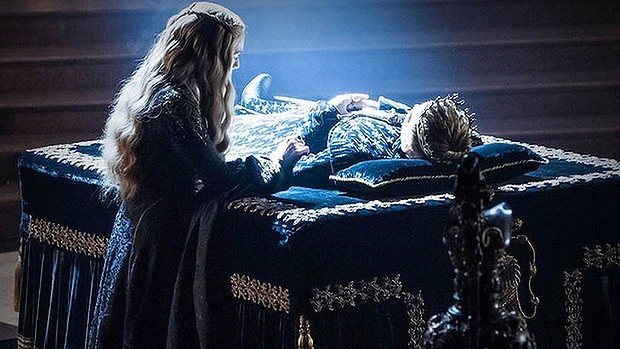
Cersei mourning in the sept
This is not to say that the men of GoT have not suffered violent deaths; Ned, Robb, Viserys, and plenty more (especially with the end of season four) can attest to that. The difference is that their deaths are not the result of new gendered violence. Sexual abuse is so pervasive on this show that it has been added where none exists, either through altering a scene or by wasting important time, that could have been used developing the series, creating new opportunities for gendered violence.
The show has many strong points, but its treatment of women is not among them. Regarding GoT, my ending remark is to take note of the cliché and to read the books as well. Good representation comes from more than numbers; it is in the treatment of the characters and the way actions against them are framed.
-contributed by Lorna Antoniazzi
 The Spectatorial
Leave a comment