This review contains spoilers up to late season two .
Needless to say, when I began watching a show whose core premise was “clones, clones everywhere,” I was not expecting much diversity. I have never been so happy to be wrong.
Though it began as a fringe show, Orphan Black has recently gained immense popularity, reaching audiences beyond those that frequent the Space channel. The show itself is a science fiction series that revolves around the scientific, moral, and ethical dilemmas that fall within the practice of cloning (and subsequently monitoring) people as “human property.” It is an in-depth take on the human side of the science: the way each clone uniquely fits into the situation and the ramifications being a clone has on both their identity and their personal lives.
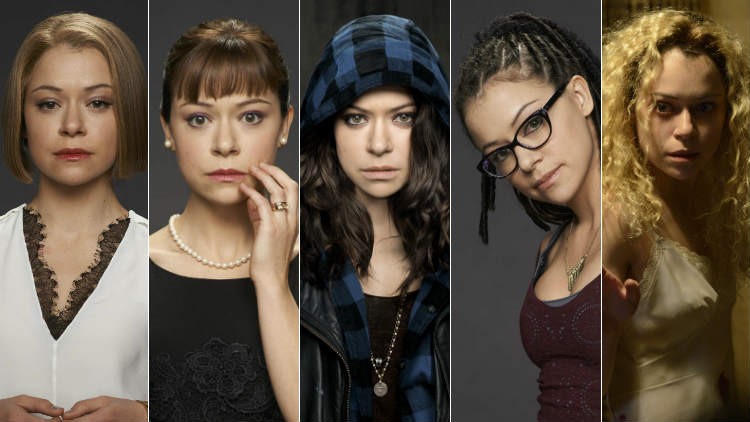
The main cast of the Clone Club (from left to right: Rachel, Allison, Sarah, Cosima, and Helena)
What has made Orphan Black stand out recently is its startling take on a prime-time television show. As of late season two, there are officially thirteen known clones inhabiting a range of heterosexual , homosexual, cisgender , transgender, and undisclosed identities. Although they share the same genetics, each clone is extremely nuanced in their personality and approach to their environments. With the combined efforts of a strong script and talented acting—Tatiana Maslany recently won the Critics’ Choice Television Award on June 19 for her outstanding performance as the clones—it is impossible to see the nine clones with speaking roles as the same person. Their biology does not define them, and, as one of the characters so aptly states in regard to her sexuality, “[it] is not the most interesting thing about [her ].” They are experiments, and though they do not fit the norm in any way , they are still—first and foremost—human.
The diverse representation on Orphan Black is important in two capacities: firstly, that there even is any; and secondly, that it is done well. Tony, the show’s first trans* character and clone, is not treated poorly by the other characters on account of his gender. There is some confusion about his identity, but it is directed solely at the fact that, up until this point, all the other clones have been cis female. Sarah (another clone, and the show’s protagonist) and Felix (her foster brother) are shocked because Tony is another stark example of how the clones vary—Tony, meanwhile, is just shocked to be a clone.
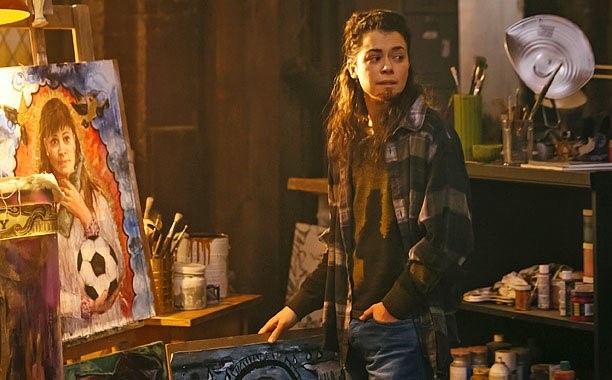
Tony has only appeared in one episode thus far—though he will be a recurring character in the future.
Moreover, the only character that struggles with remembering to use Tony’s proper pronouns is corrected. The show makes a conscious effort to amend slight slip-ups, and in doing so, purposely draws attention to the mistakes even well-intentioned people can make.
In a recent interview for The Huffington Post, the real Cosima (Cosima Herter, the show’s science consultant on whom the character with the same name is loosely based) describes Tony’s inclusion in following way: “[the writers] didn’t introduce Tony for simple representation. All the characters you see….are there to show the diversity of the real world. These are our friends, our family, our intimate relationships. They’re just people!”
The diversity of sexualities and genders on Orphan Black has been successful because the characters are so much more than just screen time for neglected identities. They are fully fleshed-out characters with their own inner lives who also happen to represent minorities. This is the difference between forced representation and good representation.
Orphan Black finished its second season on June 21st, tying it up perfectly for new viewers to marathon it in the future. I’ll be waiting for season three with bated breath!
-Gwen Wolinsk
 The Spectatorial
Leave a comment